How Submission Framing Determines Whether Autonomous Hardware Gets an AI Exclusion at All
Clear submission language on AI governance can keep autonomous hardware out of broad AI exclusions.

The quality of an underwriting submission for autonomous hardware shapes whether an insurer sees a governed physical system it can price or autonomous AI it wants to exclude. A strong submission defines the operating domain, proves the control architecture, and addresses exclusions across the policy tower. Framing can change whether an AI exclusion attaches, but only when the company’s actual governance supports the description.
Why the underwriting submission is the actual gatekeeper for AI exclusions on autonomous hardware policies
The hardware is already in the field when an incident occurs. The company submits a claim, only to find that an AI exclusion added at the last renewal removes coverage for the loss. The decisive language entered the policy before the incident. By the time the claim arrives, evidence of responsible operation cannot undo an exclusion that the placement process left intact.
That makes the submission an underwriting mechanism. Underwriters in 2026 distinguish deployments through the system description, the controls documented, and the evidence that those controls govern physical actions. The classification comes before the price. A submission that emphasizes independent decision-making without explaining its limits presents the category the exclusions target, while one that documents bounded authority gives an underwriter a basis for considering coverage.
How fast AI exclusions have spread across the policy lines that autonomous hardware companies depend on
ISO introduced three generative AI exclusions for commercial general liability in January 2026. CG 40 47 applies to bodily injury, property damage, and personal and advertising injury that arise from generative artificial intelligence. CG 40 48 applies to personal and advertising injury from AI-generated content. CG 35 08 addresses bodily injury and property damage in products and completed operations, placing the exclusion directly in the coverage relevant to deployed hardware.
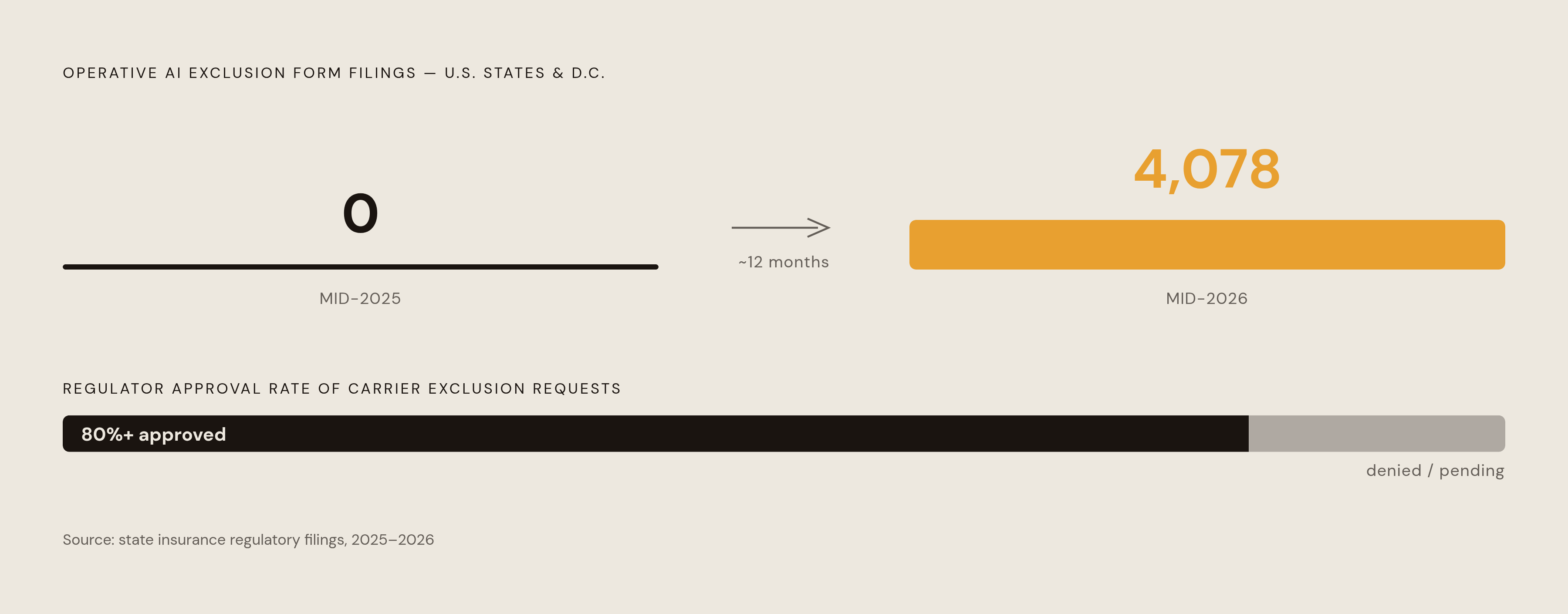
State regulators have approved more than four-fifths of carrier requests to exclude AI-related damages. Filed form adoptions of operative exclusions across states and the District of Columbia reached 4,078 through mid-2026, up from zero in mid-2025.
New York University’s Insurance of Agentic AI framework identifies the corresponding allocation problem. AI behavior, cyber compromise, professional services, and product failure can contribute to the same loss, requiring explicit allocation across policies. As exclusions spread through that fragmented structure, silence in an application gives the underwriter no evidence with which to distinguish a governed deployment from the broader category being removed.
Why autonomous hardware sits at the worst intersection of these exclusions
Autonomous hardware brings AI-directed physical operations, decisions made without real-time human approval, and paths to cyber-physical harm into one product. The NYU framework distinguishes these capabilities from information generation because they extend to planning, tool invocation, decision execution, and changes to digital and physical environments. Because of that distinction, deployed machines span insurance categories that were never designed to cover these exposures together.
A robot that navigates incorrectly and damages property illustrates the gap. The loss can be excluded under general liability through CG 35 08, disputed under cyber, and left outside Technology E&O if the firmware failure does not meet the definition of a technology service failure. Even a policy that pays for physical damage may leave production losses from the customer’s shutdown uncovered.
The NYU framework also identifies hallucinations, prompt-injection attacks, model drift, dependency failures, and cyber-physical harms as distinct pathways. When a third-party sensor fails, the company that integrates the system can face a claim alongside the supplier. Underwriters use the governed-versus-autonomous divide to distinguish those pathways and their controls.
The governed-vs-autonomous dividing line underwriters are actually using in 2026
Governed AI gives an underwriter a documented control environment, meaningful human oversight, and verifiable audit trails. Autonomous AI without that oversight presents the category exclusions are designed to keep out. This is a distinction about delegated authority. For hardware, the relevant question is not merely whether AI generates an output, but whether it can independently turn that output into an irreversible physical action.
The evidence of governance is concrete. It includes human approval workflows logged before irreversible actions, documented training datasets and validation boundaries, and a hard-coded kill switch or manual override protocol. Immutable records of autonomous actions and retained post-deployment monitoring logs support forensic review. Each control answers a different question about authority, limits, intervention, or accountability. Together, they give the underwriter more than a general assurance that the product is safe.
An autonomous agent with logged human approval workflows may get an exception that the same agent cannot get without those records. A control described after a loss is not equivalent to a record established beforehand. The submission must therefore make existing governance visible.
How do generic submissions put an autonomous robot company into the wrong insurance category?
A generic application often describes autonomous hardware in the language of a product announcement. It emphasizes what the machine decides for itself. Descriptions such as “autonomous” or “self-navigating,” without an operating envelope, align with the AI-directed physical operations that exclusion language targets. Saying that machine learning makes the decisions without documenting the control layer adds to that impression.
Standard business applications have no dedicated fields for operating domain constraints, sensor validation, intervention architecture, or the conditions under which an operator takes control. Those details may be left out or buried in free text. An underwriter then receives the capability claim without the evidence needed to bound it.
Classification can compound the omission. A general business-activity code that does not reflect physical AI deployment may route the application to an underwriter without the relevant specialization, who defaults to a broad exclusion. Where policies once implicitly covered AI because they did not exclude it, new exclusions can remove coverage unless the submission provides a specific basis for different treatment.
What specialist submission framing actually changes — and what it cannot
A specialist submission describes the same machine’s autonomy within its operating limits. It specifies the geofenced area, speed envelope, sensor redundancy, and environmental conditions. These details bound the exposure being offered. They allow an underwriter to assess a defined deployment rather than infer an unrestricted agent from a general product description.
The submission then explains the oversight architecture, including intervention conditions, intervention latency, the kill-switch protocol, and the records proving how those controls operate. Training dataset provenance, validation boundaries, monitoring logs, and AI-specific incident procedures help show how the system is governed. Performance telemetry and utilization data add evidence for pricing. Operating domain records serve the same purpose by distinguishing a monitored fleet from an undocumented one.
Specialist framing also maps that evidence across the policy tower instead of treating general liability as the entire placement. Its reach has a hard limit, however. A binding attestation about kill-switch architecture that forensics cannot substantiate can defeat the coverage the company sought to obtain. The submission cannot manufacture governance. Founders therefore need to build the control environment before they need the coverage.
Coverage lines that require specialist framing for autonomous hardware and what each one is designed for
General liability with products and completed operations addresses liability after the product leaves the company’s premises. That is the critical deployment exposure. The submission must explicitly address this coverage and document the operating domain and control architecture relevant to the AI exclusion targeting it. A generic description of manufacturing activity does not make that case.
Inland marine addresses the equipment itself as it moves to and operates at customer sites. A unit in transit falls outside the property policy described in the brief, while standard cargo liability may represent only a fraction of its value. The submission needs the hardware’s lifecycle locations. Its description must extend beyond the place of manufacture to transit and deployment.
Technology E&O applies to claims from errors, omissions, or failures in firmware and software that customers rely on, including when it fails to perform as promised. The submission must explain that technology dependency. For cyber, the submission must also address physical takeover scenarios and ask for coverage of physical system outcomes, which ordinary cyber wording cannot be assumed to include.
D&O and management liability deal with who is accountable at the company level. W.R. Berkley’s absolute AI exclusion on D&O lines shows how a shareholder claim over AI deployment strategy can fall outside coverage. Records of how the company is governed matter alongside product controls, although those records alone cannot override an absolute exclusion. These lines interact. An incident eligible for consideration under one may still encounter an exclusion under another, leaving contractual commitments unsupported.
How enterprise and government contracts are making submission quality a commercial prerequisite, not just an insurance question
Enterprise customers are starting to ask for confirmation of AI-specific coverage before they sign. A company unable to provide it may lose the deal or absorb the exposure through its contract terms. Insurance preparation therefore affects commercial access directly. The governance evidence needed for underwriting is increasingly part of the evidence customers expect before accepting an autonomous system.
The revised June 2026 draft of GSAR 552.239-7001 applies to LLM systems that process Government Data, with a scope narrower than autonomous hardware as a whole. It replaces an earlier foreign-AI prohibition with a requirement to maximize use of LLMs developed, managed, and operated by U.S.-incorporated entities subject to U.S. law and jurisdiction. Within that scope, prime contractors remain responsible for third-party AI Service Provider compliance, with due-diligence routes including flowdown requirements or attestations. The overlap with underwriting lies in documenting dependencies and responsibility.
California’s AB 316, effective January 1, 2026, adds a separate accountability constraint. It bars defendants that developed, modified, or used an AI system from avoiding liability by attributing the harm to the system’s autonomous conduct. Autonomy does not transfer responsibility away from the company. Underwriting attestations, customers’ requests for coverage, and supply-chain disclosures that apply to the business thus use much of the same governance record, so the submission puts evidence to work that the business will need again.
What autonomous hardware companies should build before their next submission — and why a specialist broker is part of that preparation
The practical preparation begins with a documented inventory of deployed models, sensors, and autonomous agents, including each component’s data access and decision authority. The operating domain should spell out geofenced areas, speed limits, environmental conditions, and when the system acts without real-time human approval. Descriptions must state authority explicitly. The oversight record should specify intervention conditions and latency, kill-switch and manual override protocols, and the logs that substantiate them.
Model governance evidence should include training dataset provenance, validation boundaries, adversarial testing results, and monitoring logs with a retention policy. Third-party dependency records should identify outside components, vendor governance requirements, and the allocation of supply-chain liability. Incident planning needs an AI-specific scope. It should cover model drift, sensor failure, hallucination-triggered physical actions, and cyberattacks that cause physical harm. These records must precede submission because binding attestations and later forensic review depend on controls that actually existed.
A specialist broker turns that operational record into a placement strategy. The work includes reading endorsements, carve-backs, and definitions before binding, translating the deployment accurately, and approaching carriers that explicitly cover autonomy. Each policy line needs its own exclusion review. Broker commissions are already included in carrier pricing whether a specialist or generalist places the policy, so specialist placement adds no separate cost beyond the premium described here.
Preparation cannot end when the policy is bound. Verisk is weighing new exclusions for agentic AI. Today’s submission needs maintenance as both deployments and policy language change. A specialist broker who keeps track of those changes helps manage risk over time.