AIG Autonomous Systems Exclusion Endorsements in Tech E&O Programs
Insurers are now explicitly excluding autonomous system risks from Tech E&O policies.

The autonomous systems exclusion endorsements now entering Tech E&O programs mark the practical end of silent coverage for autonomous operations. AIG, Great American, and W.R. Berkley have each filed exclusion language for regulatory approval, and ISO's standardized forms took effect on January 1, 2026. A company running autonomous hardware can no longer assume that losses tied to its machines' decisions fall within coverage simply because the policy never said otherwise.
Why AIG filed autonomous systems exclusion endorsements in the first place
The filings represent a structural correction, not a product innovation. That silence worked in policyholders' favor while AI-related losses stayed rare and uncertain. Accumulating litigation, regulatory pressure, and internal claims data changed the calculus, and the ambiguity became too expensive for carriers to maintain.
The industry's answer was not to build autonomous-systems coverage into the standard commercial-lines book. It was to write explicit exclusions into the policies that already existed, removing the ambiguity by removing the coverage itself. AIG did not act in isolation. Great American and W.R. Berkley filed their own exclusion versions, and Verisk's Core Lines Services unit made a multistate filing in July 2025 to give carriers ready-made language they could adopt without drafting their own.
The scale of the shift is now measurable. State insurance commissioners have approved more than 80 percent of carrier requests to exclude AI-related damages from corporate insurance policies. Verisk's Insurance Services Office has confirmed it is evaluating separate exclusions for agentic AI, which would extend the regime beyond generative models to systems that act without direct human instruction. The trajectory runs in one direction.
What standard Tech E&O policies were built to cover, and why autonomous operations never fit cleanly inside them
Tech E&O coverage was designed around wrongful acts committed by identifiable professionals delivering technology services. The coverage trigger is a negligent act, error, or omission by a defined professional. The autonomous-systems risk profile maps poorly onto a form built for professional service delivery.
Policies written before 2026 were simply silent on AI. That silence was an underwriting artifact, not an affirmative grant. Carriers had no loss data, no pricing model, and no underwriting framework for autonomous systems when these forms were drafted, so they said nothing rather than stake out a position.
The structural problem goes deeper than missing data. Autonomous systems can produce loss through several exposure classes at once. The form addresses wrongful acts in professional service delivery, not physical cascades from autonomous decision-making.
The kill-switch problem crystallizes the mismatch. Traditional machines execute fixed commands. Physical AI systems use sensors, software, and models to decide how to act as conditions change. A system that can alter its own behavior cannot be shoehorned into a form that assumes a professional made a mistake.
The specific exclusion language AIG and ISO have introduced, and what each form actually removes
The exclusion endorsements do not carve out a narrow category of AI-related loss. They remove entire classes of trigger from coverage, and the breadth of that removal only becomes visible when the specific form language is read carefully. ISO issued three generative AI exclusion endorsements effective January 1, 2026, which carriers attach to commercial general liability policies at renewal. Form CG 40 48 excludes personal and advertising injury under Coverage B arising out of generative AI, including intellectual property violations, copyright infringement, and privacy claims. Form CG 35 08 excludes bodily injury and property damage arising out of generative artificial intelligence under the products and completed operations coverage part. A third form, CG 40 47, excludes bodily injury arising from AI outputs, recommendations, or decisions.
The Verisk definition of "generative artificial intelligence" that underpins these forms is deliberately broad. It covers a machine-based learning system or model trained on data with the ability to create content or responses, including but not limited to text, images, audio, video, or code. A company that bought a third-party model and deployed it in production falls within the exclusion's reach as completely as the model's developer.
A narrower pattern targets autonomous action directly. It excludes losses arising from transactions, decisions, or commitments executed by an AI agent without human approval. W.R. Berkley's absolute exclusion, if applied to an E&O form, reaches further still: any claim based upon a director's or officer's representation about AI governance or capabilities is also excluded. Once an endorsement attaches, virtually any claim in which an AI or autonomous system played a role in producing the harm falls within the exclusion's reach.
When these endorsements attach and how a company running autonomous hardware discovers the change
These exclusions are not a future risk. Endorsements attach at renewal, not mid-policy. A company that renewed before January 2026 may still hold a pre-exclusion form, while a peer that renewed after may already carry the exclusion. Same carrier, same product line, materially different coverage.
The endorsements appear in the endorsement schedule, not in the declarations page or the insuring agreement. A four-step audit identifies whether an AI exclusion has attached. First, check the declarations page for endorsement schedules and look for "artificial intelligence," "generative AI," or "machine learning" in any endorsement title. Second, search the policy body for the word "artificial." Third, read the definitions section, since some carriers narrow existing definitions of "professional services" or "covered products" to carve out AI-produced work rather than adding a standalone exclusion. Fourth, confirm the retroactive date on a claims-made form, because past AI-assisted work may still carry protection even if the current policy excludes going-forward AI exposure.
The endorsements are optional. Two companies in the same industry holding policies from the same carrier may have materially different coverage depending solely on their renewal date. Companies that assumed AI risks were implicitly covered are finding the gaps only when a claim tests the policy, at which point the gap cannot be remediated retroactively.
What losses a company running autonomous hardware can no longer assume are covered under a standard Tech E&O form once an exclusion attaches
Once an autonomous systems exclusion attaches to a Tech E&O policy, the losses most likely to arise from autonomous hardware operations are precisely the losses most likely to fall outside coverage. Under CG 35 08, property damage caused by autonomous systems, robotics, and AI-directed physical operations, including delivery drones, automated machinery, and self-directing vehicles, is excluded from the products and completed operations coverage part. Under CG 40 47, bodily injury arising from AI outputs, recommendations, or decisions is excluded. An autonomous navigation failure that injures a worker or bystander falls there.
The autonomous-action exclusion pattern is the sharpest blade for companies running fully autonomous systems. It excludes any loss arising from a decision or commitment executed by an AI agent without human approval, which is to say it excludes the very actions that define autonomy. If it does respond, it likely covers only physical damage, not the consequential production losses that follow.
The Berkley absolute exclusion extends the exposure into the boardroom. A hardware company's leadership making statements about its autonomy stack to customers or investors carries D&O exposure that the absolute exclusion removes. The multi-policy gap compounds all of this. When each policy carries its own AI or autonomous-systems exclusion, gaps emerge between policies rather than just within any single one.
Why the Tech E&O exclusions hit autonomous hardware companies harder than software-only AI companies
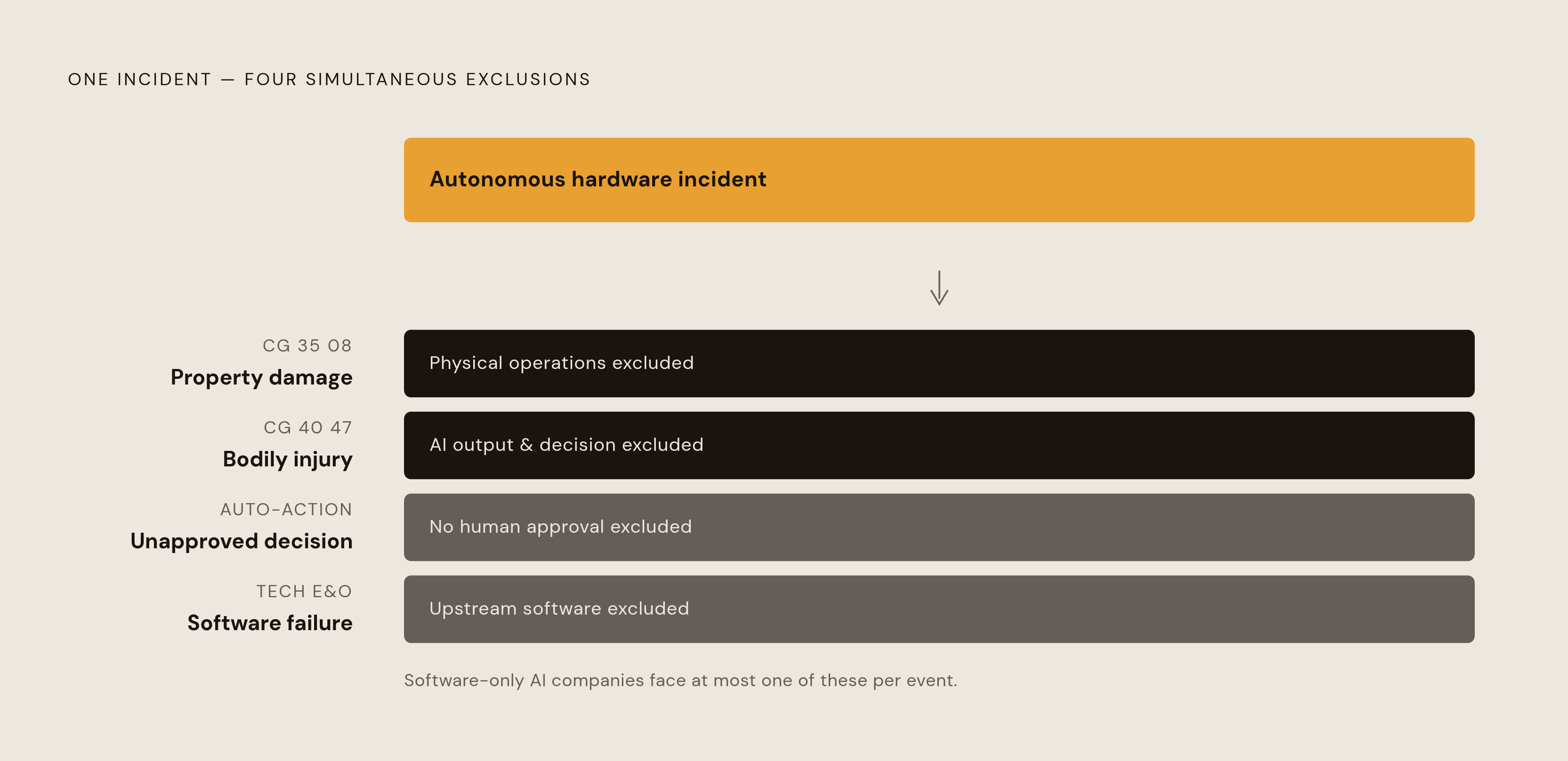
Companies deploying autonomous hardware in the field sit at the intersection of every exclusion pattern at once. A software-only AI company whose model produces a bad output faces Tech E&O exposure, but the loss is financial and professional. The exclusion question turns on whether the AI endorsement attaches to the specific policy. The company has no CG 35 08 exposure because it has no autonomous physical operations.
A company running autonomous robots, drones, or vehicles in the field faces the full stack from a single incident. CG 35 08 reaches the physical damage from autonomous operations. CG 40 47 reaches the bodily injury from AI decisions. The autonomous-action exclusion reaches decisions made without human approval. A potential Tech E&O exclusion reaches the upstream software failure. All four can attach to one event. Courts and regulators increasingly hold the organization that deployed the AI accountable, not the technology vendor that supplied it. For a hardware company that is both the developer and the deployer, there is no vendor to pass liability to.
The property side compounds the liability side. Inland marine and equipment policies may cover the physical hardware but carry cyber exclusions that strip coverage when the cause of a hardware loss is traced to a software or AI decision. The company is exposed on the property side at exactly the moment the liability side is also excluded. The kill-switch problem is structurally unique to physical autonomy. A software product can be rolled back. A drone mid-flight or a robot navigating a warehouse floor cannot pause operations while a human reviews the AI's decision. That is precisely the autonomous-action pattern the newest exclusions target.
What affirmative autonomous systems coverage looks like and what the specialist market currently offers
The market has structurally split. Mainstream carriers are narrowing standard policies by writing AI out of them. A smaller specialist market is building products that explicitly write AI and autonomous systems back in, on carefully underwritten terms. The burden now falls on the buyer to seek affirmative coverage rather than assume it exists.
The products differ in trigger structure, and each suits a different class of operator. Mosaic × aiSure, powered by Munich Re, uses defined performance thresholds with parametric-style payouts triggered automatically when thresholds are breached. The trigger links to measurable AI performance failures such as underperformance, drift, calibration errors, or prediction error, determined by pre-agreed metrics at placement. The structure works for companies that can document what normal system performance looks like. Chaucer and Armilla's Vanguard AI product combines cyber and Tech E&O coverage with standalone AI liability and predefined loss allocation rules, including a separate AI aggregate and predetermined allocation across cyber, tech failure, and AI behavior. It directly addresses the multi-policy gap problem. AXA XL's GenAI endorsement to CyberRiskConnect covers data poisoning, usage-rights infringement, and AI Act-related regulatory violations, focused on model-development and compliance risks. HSB, a Munich Re company, launched AI Liability Insurance for small and mid-size businesses in March 2026, with standard limits of $25,000 or $50,000. Larger AI vendors can access higher-limit products like Munich Re's aiSure program.
These products are not interchangeable. Each has a specific trigger structure and a specific use case, and access depends on presenting a credible, well-documented risk profile. The specialist market is real but small, and its underwriters set the terms of entry.
How underwriting submission quality determines whether a company can access affirmative coverage at all
For a company running autonomous hardware, moving from a standard Tech E&O policy with exclusion endorsements to affirmative specialist coverage is not primarily a product selection problem. It is a submission quality problem. Specialist underwriters require detailed, accurate documentation of autonomous system governance before they will bind coverage at all.
The questions specialist underwriters ask never appeared on standard renewal forms. Who owns and controls training data? How often are models reviewed or audited? What happens when systems disagree with human decisions? What agentic AI oversight controls exist? What post-deployment monitoring logs are maintained? What does the AI incident response plan cover? Companies that cannot provide clear answers face stricter conditions: tighter terms, higher retentions, reduced capacity, or outright decline. The submission quality determines both whether coverage is available and what it costs.
The controls with the highest underwriting impact include AI threat detection and behavioral analytics, documented red-teaming, NIST AI RMF alignment, and formal human oversight workflows for agentic AI. These are not compliance exercises. They are the documentation that makes a risk legible to a specialist underwriter. The submission gap is structural. A company that fills out a standard renewal form designed for conventional technology businesses produces a submission that cannot answer the questions autonomy underwriters require. The form itself is the wrong tool. A specialist broker who reads the policy forms, understands the exclusion endorsements that are attaching, and builds the submission around what autonomous-systems underwriters need to see is the mechanism by which the right carrier receives the right risk description. A generic submission routed to a general commercial-lines carrier will either return the standard exclusion endorsements or be declined entirely. For a company that has described its autonomous operations clearly, the system architecture, the human oversight protocols, the governance documentation, the deployment environment, the specialist market has products that affirmatively cover the losses the AIG and ISO exclusion endorsements remove. The path from exclusion to affirmative coverage runs through the quality of how the risk is presented, not through the absence of available products.