Lloyd's of London AI Exclusion LMA 5564 for Robotics Operators
Insurers are excluding AI-driven robotics losses they cannot yet price or predict.
Lloyd's market is rewriting the fine print around artificial intelligence, and the change is not cosmetic. Underwriters are hardening model wordings because they cannot price a risk they cannot model, and AI, particularly in robotics, produces exactly that kind of risk: correlated, systemic, and resistant to the actuarial assumptions that built the market's pricing tools.
A machine that fails the same way across a thousand deployed units at once breaks the law of large numbers that insurance pricing depends on. That is the condition driving the market's response, and it did not emerge from guesswork. The Lloyd's Market Association ran a market opinion survey in mid-2025 covering four loss scenarios directly tied to AI: professional indemnity failures, product recall, self-driving vehicle injury, and cyber business interruption [1]. The point of the exercise was to find out where AI exposure already sat inside live policies before anyone locked exclusion language into place. Respondents did not treat these as distant hypotheticals. They described AI-related professional indemnity and cyber losses as plausible now. The market is responding to exposure that already exists, not exposure it expects to exist someday.
The timing compounds the pressure. The LMA's April 2026 survey on AI risk management found that AI adoption across the Lloyd's market more than doubled over the prior year. Carriers are expanding their own internal use of AI for underwriting and claims at the same moment they are writing exclusion language around how their insureds use the same technology. So you end up with governance policy and exclusion wording built on parallel tracks inside the same institutions.
None of this started as a reaction to a single bad claim. Lloyd's 2024 Market Oversight Plan named Directors & Officers, US general liability, and cyber as the three classes carrying the greatest uncertainty from AI, and it told Lloyd's to work with the LMA so they could build an oversight framework for AI and augmented underwriting. The model exclusion language now reaching the market is the direct output of that 2024 directive, not an improvised response to a headline.
What LMA 5564 Says and How It Is Structured
LMA5564, formally titled the War, Cyber War and Cyber Operation Exclusion (No. 1), was developed by the Lloyd's Market Association. It is not a standalone AI exclusion that a managing agent simply bolts onto a policy. It can still remove coverage for losses tied to AI and autonomous system operations, including robotics, if its terms interact a certain way with the definitions already written into a given policy.
That interaction is where the real complexity sits. A policy's existing definitions of "computer system," "cyber incident," or "war" determine how far LMA 5564's language reaches once it is incorporated, and two policies that look similar on their face can produce opposite outcomes for the same loss. The clause does not establish one uniform standard across the market. If a policy carries one clause version rather than another, you might see AI exposure affirmatively covered, limited by a sub-limit, or excluded. So if you hold several policies written against different LMA model wordings, you can end up with materially different protection from one policy period to the next, even though nothing changed about how the business operates.
The mechanism that does most of the work here is the phrase "arising out of," a causal standard that courts have historically read broadly. A claim needs only a tangential link to AI decision-making for an insurer to argue the exclusion applies, which gives carriers substantial room to deny claims that an operator would have reasonably assumed were covered.
Robotics operators running networked fleets face a second layer of this problem through the cyber line. The LMA's own loss scenario survey asked about four scenarios, and it rated cyber business interruption caused by AI malfunction as the most plausible one. That finding puts the cyber policy in the position of being the first line of defense when a robot fails, and it is precisely where LMA 5564's reach through the policy's "Computer System" definition bites hardest.
How the exclusion interacts with the policies robotics operators already hold
A robotics operator's risk rarely lives in one policy. Autonomous hardware touches cyber coverage, general liability, products liability, technology errors-and-omissions, inland marine or equipment coverage, and employers' liability, often within a single incident. Because of that spread, the model AI exclusion does not threaten one line of coverage in isolation. It can open uninsured gaps across the entire program if the AI language in each policy has not been checked against the others for consistency.
The clearest danger case is a robot that causes harm through its own navigation or perception logic, with no cyberattack and no identifiable human error behind the failure. Even without an AI exclusion in play, insurers and policyholders can struggle to agree on which policy responds to an autonomy-driven loss. Layer an AI exclusion onto the cyber policy and pair it with a general liability policy that says nothing about autonomous systems one way or the other: the operator can end up with no policy willing to respond to a real loss.
The LMA's own survey work flagged a related trap buried in policy language: a policy may require that a human actor be responsible for the triggering act or event. So a human-in-the-loop requirement like this can limit coverage for agentic or fully autonomous decision-making even when the AI exclusion itself never technically applies. An operator can clear the exclusion analysis and still find the underlying insuring agreement was never written to cover a machine acting on its own.
Production-loss exposure sharpens the problem further. A standard business insurance policy may pay for the physical damage from a robot incident but decline to pay for the lost production that follows once a line goes down, and if an AI exclusion applies, the physical damage claim is also more likely to be denied when the cause traces back to autonomous software behavior.
Networked fleets carry one more collision point. The LMA's updated LMA5567A and LMA5567B clauses add a national-level infrastructure impairment threshold, a major detrimental impact on an "impacted state," layered alongside the existing attribution-based tests. LMA5567A keeps the attribution procedure in place; LMA5567B drops attribution but requires prior Lloyd's approval before it can be invoked. A fleet of connected robots caught up in a broad cyberattack could face exclusion arguments under the AI wording and the state-actor wording at the same time, with no policy clearly obligated to pay.
Why the LMA's own loss scenario research confirms the gaps operators face are real, not theoretical
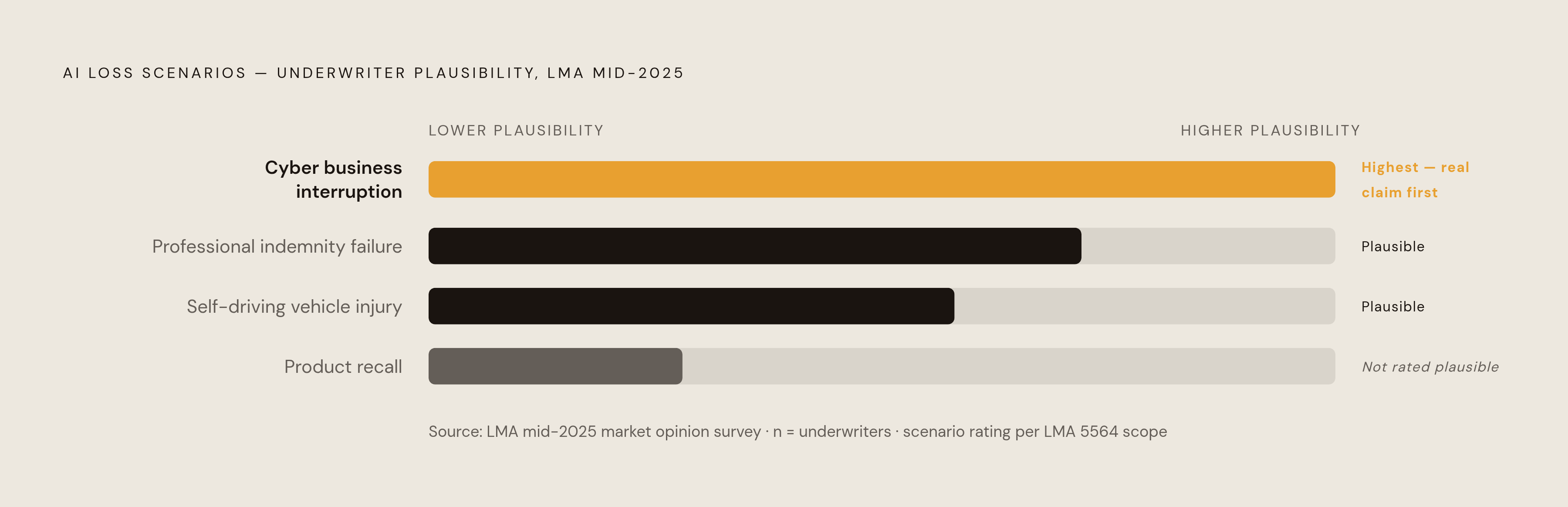
The LMA's mid-2025 survey rated three of its four tested AI loss scenarios, professional indemnity failures, self-driving vehicle injury, and cyber business interruption, as plausible. So the market's own underwriters believe these losses can and will happen under policies written today.
The cyber scenario, system downtime caused by AI malfunction leading to business interruption, scored highest of the four for viability. Underwriters consider it the scenario most likely to generate an actual claim in the near term, which matters directly to any operator running automated or robotic systems tied to a production process.
The survey's methodology deserves attention here. Respondents were asked to assume the loss was covered when they estimated its magnitude, so the figures produced do not account for the exclusions that LMA 5564 and comparable wordings are designed to insert. Once an exclusion is found to apply, whatever loss makes it through the claims process will be smaller than the survey's magnitude estimates. The survey itself noted that the level of concern and the potential scale of loss would depend on the terms and conditions of the applicable wordings and the use of exclusions. The LMA is stating that the wording itself is the variable separating a plausible loss from a paid claim.
The exposure is not static. The survey found broad agreement among respondents that AI usage in these four scenarios will grow over the next one to three years. The exposure that LMA 5564 is built to exclude is expanding on the same timeline as the exclusion itself is being adopted across the market.
Sourcing Affirmative Autonomy Coverage
Once LMA 5564 is in the picture, you cannot treat an existing insurance program as covering autonomous operations by default. Coverage has to be affirmatively written into the insuring agreement itself. Silence in a policy is not protection.
Several coverage lines need to be checked individually, each for a different reason. General liability carries the most acute version of the exclusion threat, so you need to review a CGL policy directly for AI endorsements or exclusions before you assume bodily injury or property damage from robot operations is covered. Technology errors-and-omissions coverage, sometimes written as AI liability, matters most for robotics operators specifically: it protects against claims that a machine learning model, an algorithm, or an autonomous navigation system failed to perform as promised and caused a customer a financial loss, and it needs to be checked for human-actor requirements in the insuring agreement that could void coverage the moment a decision was made without a person in the loop. Cyber coverage is not optional for any networked autonomous system, and it has to be checked both for AI malfunction exclusions and for how far LMA 5564 reaches through the policy's "Computer System" definition, as well as against the updated LMA5567A and LMA5567B state-actor language for any operator running a fleet at scale. Directors and officers coverage, which investors routinely require before closing a funding round, needs review for the absolute AI exclusions that have already been filed in the U.S. market, a risk that grows sharper wherever founders have made public disclosures about autonomous capabilities that could become the basis for later litigation.
The market writing these exclusions is also building products to answer them. In April 2025, the first managing general agent focused exclusively on AI insurance launched affirmative AI Liability Insurance at Lloyd's, and Chaucer Group underwrote it with backing from Axis Capital. The product covers AI underperformance, hallucinations, model errors, regulatory violations, and data leakage. Its existence demonstrates that Lloyd's capacity can be found for AI exposure specifically, not only excluded from it. No single product of this kind closes every gap across a robotics operator's full program, and treating one policy as a complete fix would be a mistake. The right posture is to treat affirmative AI and autonomy products as one necessary component among several, assembled against the specific shape of the operator's own coverage stack.
Why submission quality determines whether a robotics operator gets the affirmative coverage or the exclusion
Underwriters grant affirmative coverage or narrow, carefully scoped exclusions when a submission gives them enough information to actually model the AI risk in front of them. Opacity pushes an underwriter toward the exclusion by default, since excluding an unknown risk is always the safer underwriting decision. Transparency gives the underwriter a path to write it in.
This is where the LMA's own survey findings cut in the operator's favor. A majority of underwriters surveyed believe insureds are managing their AI risks adequately. It is not that carriers refuse to insure AI-driven operations on principle. If you cannot demonstrate adequate risk management, you face exclusion by default, but if you can document it, you work from solid ground with the market.
If you want affirmative coverage, your submission needs to give an underwriter a full inventory of every AI and autonomy use case in the operation, including third-party AI components embedded in sensors or perception stacks that you did not build in-house. It needs a clear account of autonomy levels across each operational stage, distinguishing where a human remains in the loop from where the system acts without one. It needs documented failure mode analysis and the results of edge-case testing, a clear picture of the cybersecurity architecture protecting over-the-air update pathways (the point where cyber risk and autonomous behavior most directly meet), prior loss history and near-miss incident logs, and regulatory status covering EU AI Act risk tier classification, FAA or FCC approvals where relevant, and any compliance documentation tied to government contracts.
A submission built around this level of detail will consistently fare better than a generic one placed through a standard broker using a standard form, because it answers the questions an underwriter needs answered to price the risk narrowly. An LMA survey found that most surveyed Lloyd's market firms already have an AI governance framework in place or in active development. Underwriters applying that same standard to their own operations will look for equivalent governance evidence from the robotics operators asking them to write the risk. A specialist broker who reads the policy wordings closely before binding, and who builds the submission around the carrier appetite that actually exists for autonomous hardware, is the mechanism that turns documentation into a bound policy. You pay nothing beyond the premium itself for that work, since broker commission is already built into the placement no matter who arranges it. The underwriters who exclude what they cannot model are the same underwriters who will write what an operator can show them clearly.
Sources
- LMA - Understanding AI Exposures: AI Loss Scenarios Survey Results
- LMA - AI adoption more than doubles across the Lloyd’s market in 12 months, with 93% of survey respondents building governance frameworks
- Lloyds publishes its 2024 Market Oversight Plan
- LMA - LMA survey maps underwriters’ views of AI loss scenarios across key lines
- LMA - Over one-third of London market firms now actively using AI