California DOI AI Exclusion Filing Activity in Commercial Lines
Insurers are rapidly cutting AI risks from corporate policies before companies notice the gaps.
State insurance commissioners have approved more than 80 percent of carrier requests to exclude AI-related damages from corporate insurance policies. This was not a proposal sitting in a regulatory queue; it was a decision already made, at scale, across the market that most companies assume will cover them. By July 2026, more than 60 property and casualty insurance groups had filed AI-related exclusions with regulators, and the Insurance Services Office, the organization that publishes the standardized policy language on which the admitted market runs, had already moved from drafting to deployment: its generative AI exclusion endorsement templates, introduced in 2025, took effect on January 1, 2026. A second wave is already forming. Verisk confirmed in July 2026 that it is weighing new exclusions aimed at agentic AI: the companies building and deploying autonomous hardware in California are not watching a slow-moving regulatory debate. They are operating inside a market that has already closed one door and is sizing up the next.
What the three ISO forms exclude
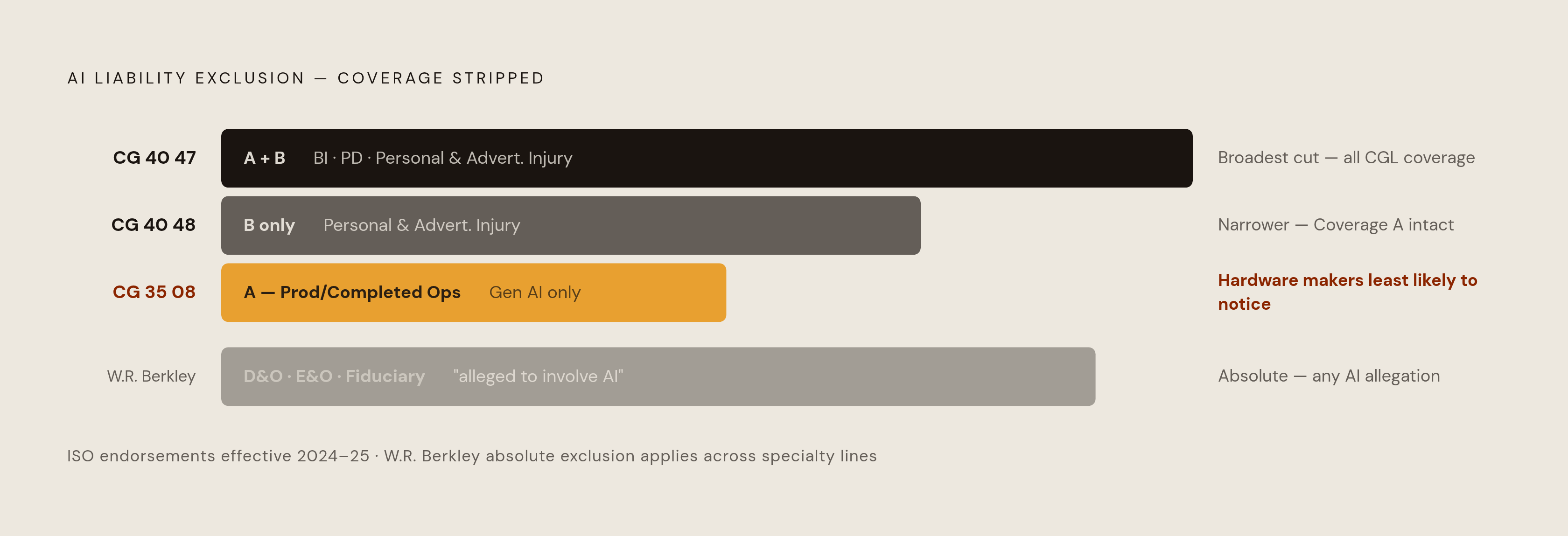
The three ISO endorsements that took effect on January 1, 2026, do not carve out some narrow category of "AI gone wrong." They remove entire classes of injury and damage from the core coverage sections that autonomous hardware operators depend on. CG 40 47 excludes bodily injury, property damage, and personal and advertising injury arising out of generative AI under both Coverage A and Coverage B of a standard commercial general liability policy. CG 40 48 is the narrower sibling, limited to Coverage B, personal and advertising injury only. CG 35 08 applies the same generative AI exclusion to products and completed operations coverage, the section that matters most to hardware makers and system integrators, since it is the part of a CGL policy meant to respond when a shipped product or a finished job causes harm after the fact.
W.R. Berkley has built something broader still: an "absolute" AI exclusion for directors and officers, errors and omissions, and fiduciary liability products. The language eliminates coverage for any claim "based upon, arising out of, or attributable to" the actual or alleged use, deployment, or development of artificial intelligence, and it applies regardless of whether the AI in question was used by the insured or by any other person or entity. The phrase "actual or alleged" carries the most weight in that sentence. A plaintiff does not need to prove AI was involved in the harm. The plaintiff only has to assert it, however weakly, for the carrier to invoke the exclusion and walk away from the claim.
Why the exclusions are hard to spot at renewal
Coverage erosion from AI exclusions is built to be invisible at renewal. An operator who does not actively audit a program against these exact form numbers will find out about the gap only after a claim has already been denied. The industry has run this pattern once before. Between 2015 and 2023, standard policies unintentionally covered cyber losses they were never designed to handle, a problem the industry labeled "silent cyber," and carriers resolved it the same way they are resolving silent AI now: through exclusion. The market is moving away from implicitly covering AI risk inside existing cyber and Tech E&O policies, replacing silence with explicit carve-outs.
An AI exclusion does not appear as a single line item labeled "AI exclusion" on a renewal summary. It arrives through revised base forms, new AI-specific endorsements, changed definitions buried in policy language, new underwriting application questions, internal underwriting file positions that never reach the policyholder, or restrictive carve-backs negotiated quietly between broker and carrier. A policy that covered a robot malfunction at last year's renewal may not cover the same malfunction this year, with nothing on the declarations page to signal the change. Passive renewal management, simply accepting a renewal proposal without checking it against current exclusion language, is now a risk management failure in its own right for any company running autonomous hardware.
Liability exposures that autonomous hardware creates, already awkward for standard policies
Physical AI systems were straining standard liability frameworks before a single exclusion form existed. A malfunction in an autonomous system can trigger product liability, professional liability, and property damage claims all at once, and those claims cross coverage lines in ways that leave gaps between policies even when each policy works as designed.
What breaks down is structural. Physical AI systems use sensors, software, and models to decide how to act as conditions change in real time, and that adaptive decision-making undermines the "accident" framing that traditional CGL policies require. A standard business insurance policy may not respond to a robot incident at all, either because it carries an AI exclusion or because the loss does not meet the policy's definition of an accident. Even where a policy does respond, it typically pays for physical damage only, not the production losses that follow when a robot failure shuts down an operation for days or weeks.
Product liability law complicates the picture further. It applies when a defect in hardware, software, or training data causes harm, covering manufacturing defects, design defects, and failures to warn, and it can attach to original equipment manufacturers, software developers, and system integrators alike. Model providers' own terms of service push liability downstream: the contractual relationship sits between the deploying company and its customer, not the lab that trained the underlying model. The company standing in the middle holds the exposure even when the failure originated somewhere upstream it never controlled. A single malfunction can cross CGL, Tech E&O, and products/completed operations coverage at once, so gaps open between policies unless you assess the whole program together.
California law has raised the stakes on top of this. AB 316, effective January 1, 2026, bars any party that developed, modified, or used AI from asserting that the AI acted autonomously as a legal defense when a product causes harm. Developers, modifiers, and deploying companies alike lose the argument that the AI caused the harm on its own. Every autonomous hardware operator in the state now faces higher litigation stakes at the exact moment its insurance coverage is narrowing.
Coverage lines directly affected for an autonomous hardware operator
The exclusions do not strike every coverage line with equal force, but the lines taking the heaviest hits are the ones an autonomous hardware operator cannot run a business without.
Commercial General Liability is the first line of defense against claims for bodily injury and property damage, and the ISO forms CG 40 47 and CG 35 08 cut AI-related losses directly out of Coverage A and out of products/completed operations, the sections that matter most when a device injures someone or damages property.
Technology E&O, also called professional liability, is the workhorse for claims where a system produces a wrong result and a customer loses money as a result. General liability was never designed to pay a professional failure claim, and Tech E&O is the line built for exactly that gap, which makes it the line carrying the most aggressive exclusion activity through August 2026, driven in part by W.R. Berkley's absolute exclusion language.
D&O protects company leadership when they are sued personally over business decisions, and venture-backed companies typically bind this coverage at the first priced round because term sheets require it. For AI hardware companies, public statements about what a system can do function as statements to investors, and overstated capability claims are an active target for both lawsuits and regulatory scrutiny, which is precisely where W.R. Berkley's absolute exclusion reaches.
Inland marine, or equipment and hull coverage, insures the physical UAV or robotics asset itself, separately from the third-party liability coverage that responds when that asset harms someone else. If operators treat the two as interchangeable, they risk a gap the moment a single crash causes both asset loss and third-party harm.
Cyber coverage matters here because autonomous systems depend on sensor networks and data pipelines, a line where silent AI coverage was common and is now being systematically stripped out.
Aviation and UAV-specific liability governs operators under FAA jurisdiction, a distinct line from standard CGL with its own set of carriers. Space coverage, for companies running satellites or launch vehicles, sits entirely outside the standard admitted market and follows its own rules.
How enterprise and government contracts expose coverage gaps before a claim happens
A coverage gap created by an AI exclusion does not wait quietly for a claim to surface it. It becomes an unfunded liability the moment a customer's contract requires coverage the policy no longer actually provides. Enterprise customers have started asking for AI-specific coverage confirmation before they will sign, and a company that cannot produce it faces one of two outcomes: walk away from the deal, or absorb the exposure inside its own contract terms without the insurance to back it.
Standard enterprise contract stacks typically require CGL, Tech E&O or cyber, and workers' compensation at substantial limits. Larger clients, particularly in healthcare, finance, or government, often push for significantly higher Tech E&O limits and may add D&O as a condition of the deal. Government contracts add regulatory terms on top of that: higher limits, additional insured status, and waiver of subrogation, all of which assume admitted-market coverage is simply available and unrestricted. When an AI exclusion quietly voids the coverage a certificate of insurance was supposed to confirm, the operator is technically in breach of its own insurance covenant, a contract-level problem that can appear during a routine compliance review, long before any underlying incident. The exclusions turn what looks like a policy compliance question into a revenue problem, capable of stalling or killing a contract before any robot, model, or sensor ever fails.
Where coverage for autonomous hardware still exists
The admitted market's exclusion activity is concentrated in standardized ISO forms carried by major admitted carriers, and it has not spread evenly across the entire insurance landscape. Lloyd's syndicates, surplus lines carriers, and specialty markets that underwrite autonomous systems, UAVs, and defense technology operate under different frameworks, and they have not uniformly adopted the same exclusionary language. At least one YC-backed brokerage focused specifically on AI, robotics, space, and defense has reported that traditional insurance products fail for these risk classes, confirming that a specialist market exists and is actively placing coverage for exactly this kind of operator.
Reaching that market takes a different kind of submission than the admitted market expects. Underwriters there want a clear account of use cases and target industries, sensor and data architecture, model risk assessments, adversarial testing evidence, and alignment with recognized frameworks such as the NIST AI Risk Management Framework. They expect vendor risk documentation that treats third-party AI components as company risk. Contract review is part of the underwriting process itself: specialist underwriters examine liability caps against policy limits, indemnification obligations, and scope definitions, because ambiguous contract language is one of the most common sources of Tech E&O claims and feeds directly into how a policy gets priced and written. If brokers read the policy language before binding, rather than routing operators into generic admitted-market forms, they connect the right submission to the right carrier. Broker commission is already built into the premium regardless of who places the policy, so working with a specialist costs the premium itself, not an added fee on top of it.
What operators should do now in the California market
The ISO forms are already in effect, a second wave targeting agentic AI is already forming, and California law has simultaneously raised the litigation stakes through AB 316. Waiting for the next renewal to see what happens is no longer a defensible strategy for any company running autonomous hardware in the state.
Start by checking whether CG 40 47, CG 40 48, or CG 35 08, or language functionally equivalent to them, appear anywhere in the current CGL policy or in the renewal proposal sitting on a desk right now. Run the same check against Tech E&O and D&O policies, looking specifically for absolute AI exclusion language of the kind W.R. Berkley has written into its forms. Treat the entire insurance program as one connected system rather than a stack of separate policies, since a single malfunction can cross CGL, Tech E&O, and products/completed operations at once, and a gap in one line can defeat coverage that looks intact in another. Review enterprise and government contracts for insurance covenants that assume unrestricted admitted-market coverage still exists, because a certificate that once satisfied a customer's legal team may no longer match what the policy actually pays. Where the admitted market has closed a door, the specialist and surplus lines market remains open, but only to operators who submit the kind of technical and contractual documentation that specialist underwriters are actually asking for. California's regulatory and legal environment has moved fast in 2026. The companies that treat their insurance programs with the same rigor they apply to their engineering will be the ones still standing when the next wave of exclusions arrives.