Travelers AI Exclusion Filings in Commercial General Liability Policies
Insurers are quietly blocking AI liability coverage through standardized policy exclusions.

State insurance commissioners have approved more than four out of five carrier requests to exclude AI-related damages from commercial policies, CSIS's analysis found. For most of the generative AI boom, a gray zone existed in which CGL policies covered AI-related losses simply because no one had written AI into the policy language or out of it. That gray zone is closing now, and it is closing through explicit endorsement filings rather than through court rulings or legislation, which means the shift is happening inside insurance paperwork long before most policyholders notice it.
The mechanism behind the shift moved fast once the approvals came through. The Insurance Services Office, the Verisk subsidiary whose standardized language most U.S. admitted-market carriers build their policies from, introduced generative AI exclusion endorsements, and they took effect January 1, 2026. Carriers holding regulatory approval got a ready-made set of forms, so they could attach them at renewal instead of drafting bespoke exclusion language state by state.
The underlying driver is not a carrier deciding that AI is dangerous, but an insurer that cannot satisfy enough of those nine criteria defaulting to exclusion.
The stakes of that response are not abstract. For many businesses, an activity that cannot be insured is an activity that is effectively prohibited, and CSIS points to a working example outside the AI context entirely: the withdrawal of maritime protection and indemnity insurance that strangled Iranian oil exports without a single shot fired. Insurance has become a de facto regulator in exactly this way for AI deployment, and right now it is regulating by withdrawal rather than by setting affirmative standards that AI systems could be built and priced against.
The three ISO forms and what each removes from a standard CGL policy
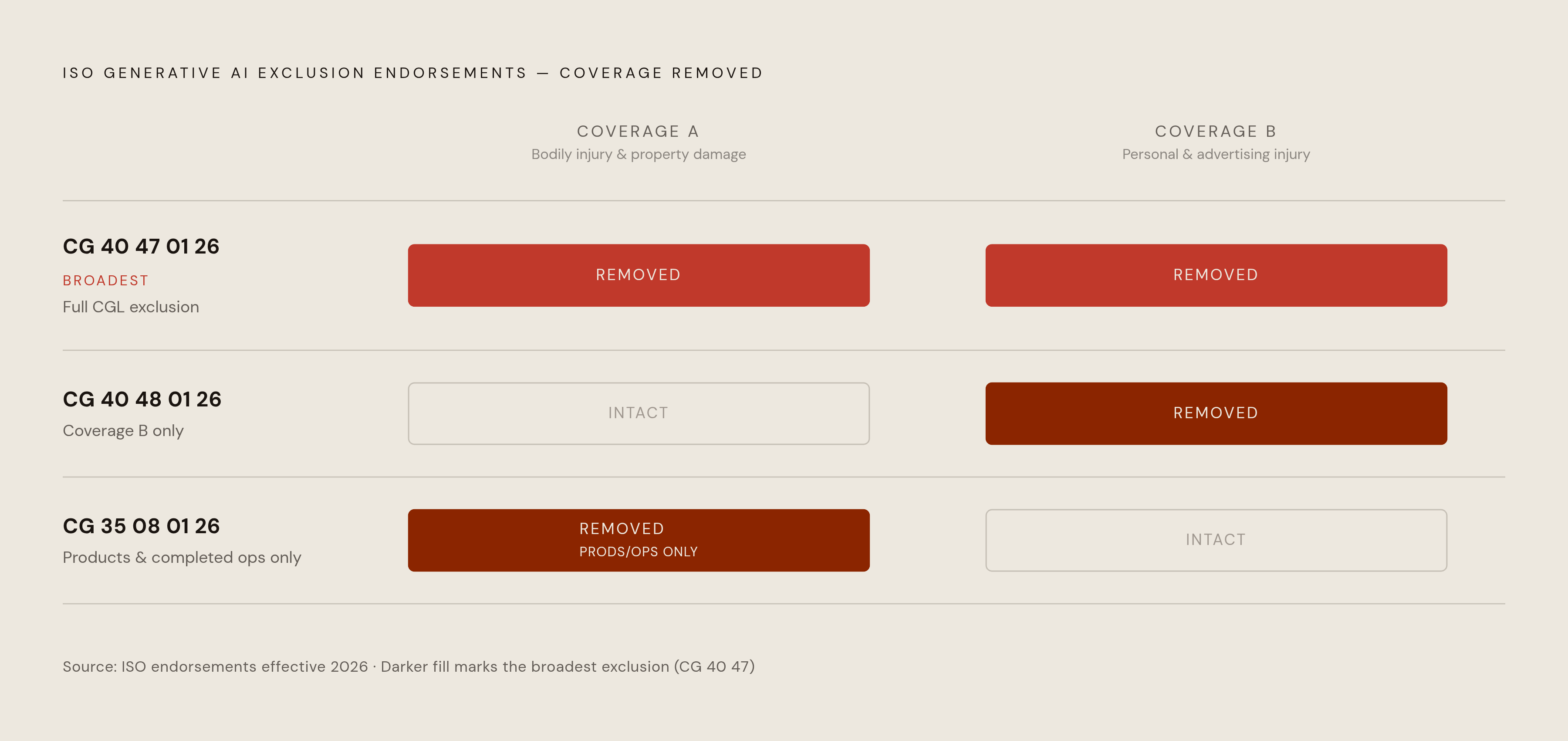
Three ISO generative AI exclusion endorsements now exist, and each one cuts into a different part of a standard CGL policy. Read together, they can strip most AI-related liability out of a policy that, on its face, still looks like ordinary commercial coverage.
The broadest of the three is CG 40 47 01 26. It reaches both Coverage A, which handles bodily injury and property damage, and Coverage B, which handles personal and advertising injury. That breadth matters because it means the exclusion is not confined to marketing or reputational harm. CG 40 47 does not distinguish between a physical-world accident and a paperwork failure; if AI is in the causal chain and the form is attached, both fall outside coverage.
CG 40 48 01 26 works differently, and that distinction is the single most important technical point in this entire policy-language landscape. CG 40 48 reaches Coverage B only, personal and advertising injury, and leaves Coverage A, bodily injury and property damage, untouched. A business that cannot tell these two forms apart, or that assumes one AI exclusion is the same as any other, can misjudge how exposed it is in either direction.
The third form, CG 35 08 01 26, operates on the products and completed operations section of the policy. It removes bodily injury and property damage that arise out of generative artificial intelligence from that specific coverage part. This is the form that matters most for companies whose products act physically in the world under AI direction, a category this piece returns to below.
These three forms are the documented floor of what carriers file through the ISO's standardized language. They are not the ceiling. Some carriers have gone considerably further on their own, and a policyholder who checks only for these three ISO form numbers may miss exclusion language that reaches wider still.
Carrier-specific absolute exclusions beyond the ISO floor
Berkley Insurance Company has filed an exclusion, form PC 51380 00, edition June 2024, and its scope dwarfs the ISO language in nearly every dimension. The ISO forms are scoped specifically to generative AI, but Berkley's exclusion is labeled "absolute" and does not limit itself to generative outputs. Its language covers "any actual or alleged use, deployment, or development of Artificial Intelligence" by any person or entity, a phrase broad enough to reach well past chatbots and content generation into any system that could reasonably be called AI.
The reach of the Berkley form extends across coverage parts that the ISO endorsements do not touch in combination. So an AI hiring screen, an AI-assisted board decision, and a fiduciary investment recommendation made with AI assistance can all fall under a single exclusion in a single policy family. A company that checked its CGL form and found no AI exclusion language could still be carrying one in its D&O or fiduciary liability policy without realizing the two are connected by the same underlying carrier logic.
You cannot speculate about Travelers' own position on carrier-specific language, so it needs care. What has not been established is whether Travelers intends to file proprietary absolute language in the manner Berkley has, or whether it will rely on the ISO forms as its primary mechanism. The honest position is that this remains unresolved on the public record, and a policyholder should not assume the answer in either direction.
What can be stated with confidence is the practical implication for anyone auditing a policy. Even if a given carrier adopts no proprietary exclusion of its own, the ISO forms are already a live mechanism moving through the market, effective since January 1, 2026, and approved for use by multiple major carriers. If you check for CG 40 47, CG 40 48, and CG 35 08 by form number, you have run the baseline audit every commercial policyholder needs, regardless of what any single carrier does beyond that floor.
Why "arising out of" is the phrase that determines how broadly these exclusions reach
Every one of these exclusions, ISO or carrier-specific, turns on a single phrase: "arising out of." That phrase is doing more legal work than most policyholders assume when they read it.
"Arising out of" requires only a causal connection between the harm and the AI system in question. It requires only that a connection exists somewhere in the chain of events leading to the claim. That threshold is low, and it is low by design: broad causal language is what lets an exclusion sweep in scenarios the drafters may not have specifically anticipated.
This consequence appears most clearly in claims that do not look, on the surface, like AI claims at all, where the exclusion language generally does not distinguish AI as the core product a company sells from AI as one incidental tool buried inside a larger process. Scale and centrality to the business model do not narrow the exclusion; causation alone does the work.
A Canadian tribunal decided the Air Canada chatbot dispute on liability rather than insurance coverage, but it still shows what the liability half of this picture looks like. The lesson for coverage purposes is that liability attaches to the company regardless of whether the specific AI behavior was foreseen, while the exclusion language above can simultaneously remove the insurance that would otherwise respond to that same liability. Companies own what their AI systems do. Whether a policy covers the consequences of that ownership is now a separate and considerably more uncertain question.
Additional coverage gaps for autonomous systems and robotics
Companies that build or deploy autonomous systems and robotics face a particular version of this problem, and it compounds rather than simply repeats what has already been described. The CGL exclusions remove coverage that was, for these companies, already an imperfect fit for the kinds of losses they actually experience. What remains after the exclusions is a policy architecture built for an earlier assumption: that bodily injury and property damage come from human-caused events. So if an autonomous agent causes loss without direct human intervention at the moment of harm, it can fall outside a CGL policy's basic insuring agreement before any exclusion language is even reached.
CG 35 08, the products and completed operations form described earlier, speaks directly to this category. It targets bodily injury and property damage arising out of generative AI within the products/completed operations liability section, so it is the form most relevant to robot manufacturers, autonomous vehicle operators, and any company whose product takes physical action in the world under AI direction.
A single robot incident frequently produces liability claims against three separate parties at once: the hardware maker, the software developer, and the company operating the system in the field. That three-way structure is not something any single existing policy form was built to resolve cleanly, a gap noted in research on how product liability coverage responds to these incidents through Gallagher Re's analysis. In many autonomous system failures, that production loss, not the physical harm, is the larger economic consequence, and it sits in a part of the coverage landscape that conventional product liability was never built to reach.
The insurance market's incomplete replacement for CGL coverage
Specialist products for AI and autonomous-system risk exist, and the market for them is growing, but they do not yet add up to a full replacement for what the CGL exclusions are removing. Real gaps remain between what carriers exclude and what the specialist market covers now.
Technology errors and omissions coverage, sometimes bundled as professional liability, is the most mature of these adjacent products. It responds when an AI system produces a wrong output, a client relies on that output, and the client loses money as a result. That coverage addresses financial harm to clients directly. It does not address bodily injury or property damage suffered by third parties, which is the exact category the CGL exclusions are carving out.
Combined products bundling technology E&O, media liability, and cyber coverage have emerged, and they broaden that response somewhat. Chubb's DigiTech ERM and Beazley's MediaTech are examples of this category; each gives a professional-liability response for technology products and services, including client financial loss that arises from faulty AI software or service performance. These products widen the financial-harm coverage considerably, but they are still anchored in the same basic category: loss to a client or counterparty, not bodily injury or property damage to an unrelated third party.
AIG's CyberEdge Plus addresses a more specific pathway: bodily injury, property damage, business interruption, and product liability that result when a cyber attack causes the harm. An AI navigation failure caused by a flawed model rather than a hacker sits outside what CyberEdge Plus is built to answer.
Axis Insurance has built a program specifically for companies that make and deploy autonomous robots. That last piece addresses the production-loss gap described in the previous section directly, which makes it one of the more complete answers available for autonomous hardware companies specifically. Even so, if a program is built for one category of company, it cannot substitute for a general-purpose replacement of everything CGL exclusions remove across every industry now carrying AI exposure.
Underwriting submission quality and frontier tech coverage outcomes
The information asymmetry driving carriers toward exclusion is the same gap that a well-built underwriting submission can close. Submission quality is therefore not a paperwork formality. It is the mechanism that determines whether a company ends up covered or excluded.
There is no standardized set of underwriter questions yet for how a given client actually uses AI day to day. The submission itself functions as the underwriting intelligence. A broker who volunteers well-organized AI governance documentation at the submission stage is not exceeding normal expectations. That broker is the channel through which an underwriter receives the information needed to bind coverage.
A specialist broker who reads the actual policy language before it binds, and who builds the submission around the insured's real AI deployment profile rather than slotting an autonomous hardware company into a generic commercial form, is the mechanism that turns a company's internal governance work into an actual coverage placement. The governance documentation does the company no good sitting in an internal compliance folder. It has to reach the underwriter in a form the underwriter can use.
An audit checklist for businesses deploying AI or autonomous systems before renewal
Understanding the scope of these exclusions only pays off if it leads to specific action before the next renewal date. Four steps follow directly from the policy-language analysis above.
First, identify whether AI exclusion endorsements are already attached to the current policy. If the policy renewed after October 2025, there is a meaningful chance one of these endorsements was added without an explicit conversation flagging the change.
Second, map everywhere AI actually operates inside the business.
Third, assemble the governance documentation that underwriters are signaling they need before they will write affirmative coverage. That means a current inventory of AI tools and models in production, documented risk assessments completed before each deployment, evidence of adversarial testing for any system that acts on production data, and a clear map of where human oversight sits and who signs off on outputs before they reach customers or downstream systems. This same documentation does double duty: it is what a specialist broker needs to build a submission capable of reaching specialist carriers, and it is increasingly the evidence that enterprise and government customers want to see before they will sign a contract.
Fourth, engage a broker who covers the relevant specialist carriers and who actually reads the forms. Skipping this step means a company learns only after a loss how much of the policy never applied.