The Robotics Product Liability Questions a Broker Must Answer Before You Sign the Engagement Letter
Brokers must identify AI exclusions and coverage gaps before robotics companies sign.

An insurance broker for autonomous systems and robotics companies must explain what coverage pays for when software causes physical harm, check each policy for AI exclusions, and make sure the insurance fits the customer contracts. The engagement decision should turn on those answers. For a company deploying autonomous mobile robots in warehouses, the strongest evidence is a coverage plan built around its actual systems, operating sites, and contractual duties.
Why standard product liability law is struggling to keep up with autonomous systems
Under traditional product liability, manufacturers were subject to strict liability, while service providers were judged under negligence principles. Robotics-as-a-service has blurred that distinction because a service deployment can expose people to a defective physical product controlled by software. Foley Hoag’s October 2026 analysis says courts are increasingly using product liability principles to judge these systems.
The claims that follow involve failure-to-warn, manufacturing defect, and design defect. Manufacturing defect asks whether a unit was made as designed, while failure-to-warn asks whether the company did enough to explain the system’s limitations. That communication must reach purchasers, safety managers, supervisors, and bystanders. Operational design domains, the validated conditions under which a system should work, are difficult to explain plainly. Design defect tests add another uncertainty because consumer expectation and risk-utility do not map cleanly onto autonomous decisions, inviting arguments about alternative sensors, motion planners, or speed limits.
Regulation is also broadening the scope of liability. The EU’s revised Product Liability Directive expressly includes software and AI within strict liability, took effect December 8, 2024, and must be transposed by December 9, 2026. Investors now routinely examine product liability exposure in robotics diligence, including insurance adequacy, indemnity terms, incident history, regulatory posture, and safety documentation.
How a single robot incident can simultaneously trigger multiple overlapping claims that standard policies were not built to handle together
The hardware maker, AI model supplier, operator setting the operating rules, and integrator assembling the system may each bear partial responsibility. Contracts divide their duties while leaving the cause of a loss unresolved, creating a fragmented liability chain that becomes an insurance problem when policies assume separate causes for physical harm, technology failure, and cyber events.
The critical claim sits between those categories. A software decision that injures someone crosses the line between a software failure that causes only economic loss and an accident caused only by mechanical failure. Standard business insurance may exclude the loss or fail to fit it within its definitions. Even when physical damage is covered, the policy may leave production losses after a shutdown unpaid.
A widely deployed model also changes the scale of potential loss. Unlike a fire or hurricane, a model flaw is not geographically bounded and can affect systems across industries and countries. Insurers are still learning to price that accumulation risk. Recognizing these problems is necessary, but the engagement decision depends on whether the broker can explain how the proposed coverage addresses them.
The AI exclusion wave that is quietly reshuffling which losses are covered at renewal
A renewal can narrow coverage without changing the policy’s name or declared limits. AI exclusions are being added across standard forms, so what a company thought was covered last year may no longer be covered. A broker must distinguish an affirmative grant of AI coverage from a policy that simply says nothing about it.
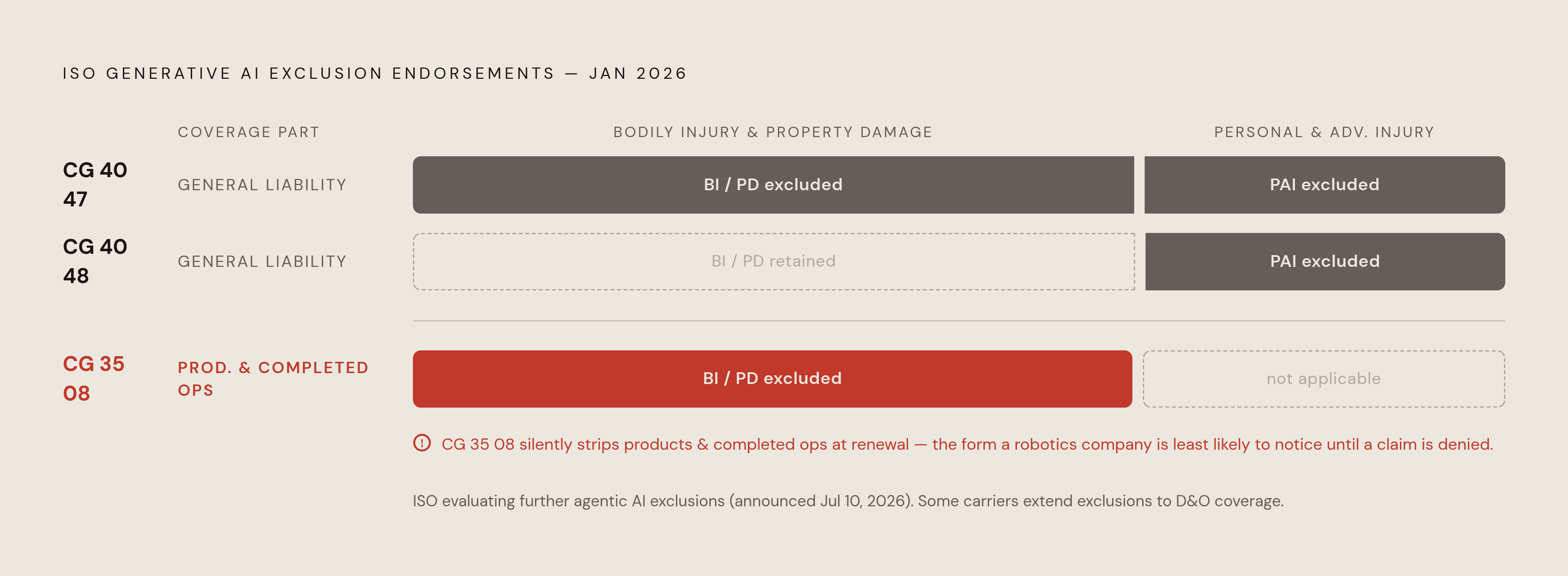
ISO, Verisk’s standards body, introduced three optional generative AI exclusion endorsements with a January 2026 edition date. CG 40 47 excludes bodily injury, property damage, and personal and advertising injury that result from generative AI across the commercial general liability coverage part. CG 40 48 excludes only personal and advertising injury. CG 35 08 is the form that applies to bodily injury and property damage under the products and completed operations coverage part. These endorsements apply specifically to generative AI.
Carriers choose whether to attach those forms, and some have written terms that exclude more, including exclusions that reach directors and officers cover. ISO stated on July 10, 2026, that it was evaluating additional exclusion options for agentic AI. The market therefore includes affirmative coverage, broad exclusions, and silence, with renewal potentially moving a risk into an excluded, sublimited, or specially conditioned category. A broker unable to identify, policy by policy, whether an AI exclusion attached at the last renewal is not performing the required review.
The coverage stack a robotics company actually needs and where standard policies leave gaps in each layer
General liability and product liability address bodily injury and damage to third-party property, but a standard commercial general liability policy may not respond where AI software is not treated as a product. Products and completed operations coverage requires particular scrutiny because CG 35 08 can exclude generative AI-related harm there. The broker must answer whether that endorsement or equivalent wording applies and, if so, what fills the gap. A declared limit does not answer it.
Technology errors and omissions must cover the financial fallout when a software error causes physical harm as well as when it causes only economic loss. In robotics, hardware and software are parts of the same product. The broker must examine how the proposed Tech E&O wording interacts with bodily injury and property damage provisions elsewhere in the stack. Contractual liability caps, accepted indemnities, and definitions of promised performance also shape underwriting outcomes.
Standard commercial property coverage stops at the insured’s own walls, while inland marine follows hardware that works at customer sites, on public roads, or in the field. Cyber adds another potential seam because an attack or data poisoning can corrupt models, disable robots, halt production, and generate third-party claims. The broker must distinguish coverage for the robot itself from coverage for the harm it causes, rather than treating equipment and liability protection as substitutes.
Directors and officers coverage needs its own AI review. Applications must address regulatory uncertainty, investor communication, board controls, and AI-related litigation exposure because explicit AI exclusions have widened that gap. Recall costs are separate again. Standard liability generally does not pay to recall, retrofit, replace, or withdraw a defective fleet, so specialized product-recall or recall-expense coverage is needed where available. Waymo’s recall of nearly 3,900 robotaxis after a software glitch illustrates that fleet-level exposure, including the need to allocate recall costs through supply, integration, and deployment agreements.
How underwriters actually price autonomous risk — and why the submission quality determines what you pay and what gets covered
Thin historical loss data makes architectural evidence and governance documentation central to autonomous-risk underwriting. Underwriters look at how well developed the architecture is, third-party security audits, and how often adversarial testing takes place, rather than relying on well-established loss patterns for an equipment class. Vague descriptions weaken the submission before wording is negotiated. A specialist’s advantage begins with explaining the system accurately.
That explanation must include every AI system the company uses, builds, or deploys, including vendor tools, internal models, customer-facing features, and agentic systems taking autonomous action. Model inventories, risk registers, and clear steps for approving deployment back up the description. Governance cannot remain an unsupported assertion. Some carriers require model risk assessments and adversarial testing aligned with frameworks such as the NIST AI Risk Management Framework, while undocumented claims of maturity can amount to underwriting “AI-washing”.
Logs provide another distinct underwriting input. Insurers need forensic evidence of what a system perceived and decided before an incident, and companies without high-fidelity logs face worse terms or absolute exclusions. Structured governance can therefore improve both price and coverage terms. Placement timing also needs to reflect the smaller pool of carriers with appetite for autonomy. A pilot delayed by a missing certificate of insurance exposes a planning failure before operations begin.
The insurance obligations buried in enterprise and government contracts that expose a gap before deployment begins
Enterprise and government contracts can require insurance and indemnities beyond the protection a standard policy provides. Tech E&O and cyber are typically non-negotiable in AI vendor contracts, while larger contracts demand higher per-occurrence limits. Limits alone do not establish a match. Broad indemnities may cover all losses arising from vendor performance, extending beyond the risks the policies cover.
Accuracy guarantees, uptime guarantees, IP indemnities, and obligations covering a customer’s permitted use of AI output can extend that mismatch. Enterprise procurement teams more often ask for affirmative AI-specific liability coverage instead of accepting a standard policy that has no AI exclusion. The broker’s task is therefore to read the contracts before placement and compare accepted obligations with actual policy wording. That comparison includes defense obligations, liability caps, personal-injury carve-outs, recall cost allocation, and post-incident data access.
Operating requirements can create a separate minimum. California requires $5 million for autonomous vehicles, while Alabama mandates a multi-million-dollar minimum for automated commercial trucks without a driver on board and Arkansas sets a lower threshold. A broker placing vehicle coverage must know the operating state’s requirement as well as the customer’s terms. Signing first and insuring second is how a company discovers that its newly accepted obligation is uninsured.
What questions should a robotics company ask an insurance broker before signing the engagement letter
The diagnostic conversation should begin with a request to trace a software decision that causes physical injury through the proposed policies, including response order and unresolved gaps. An answer that stops at general liability misses the blended claim. The company should next ask whether the broker has placed coverage for robotics-as-a-service deployed at customer sites and supported remotely. The broker should have worked through how liability applies to products and services as well as having software clients.
The exclusion discussion should ask whether existing or proposed policies include CG 35 08, CG 40 47, CG 40 48, or equivalent carrier-specific wording. The answer needs to identify actual endorsements. A further question should establish the specific coverage mechanism that replaces products and completed operations protection if an exclusion attaches. The broker should also explain how agentic AI exclusion developments are tracked and communicated before renewal.
The deployment discussion should establish how inland marine follows robots to customer sites and how equipment protection differs from liability for site damage. Cyber needs a separate failure scenario. The broker should identify which policy responds when an attack takes over a robot and causes third-party physical damage, and whether that response is established in writing. A fleet-wide software defect should then test recall protection, retrofit costs, and contractual cost allocation. Omitting recall leaves a distinct first-party exposure unexplored.
The submission discussion should ask how the broker will describe the systems to underwriters and whether the company can review that description before it goes out. A specialist asks for model inventories and governance evidence covering internal systems and third-party tools. The carrier discussion should ask whether carriers want to cover autonomous systems or are simply willing to leave AI unmentioned.
The contract discussion should ask whether the broker will read customer agreements before placement to check what insurance they require and what indemnity obligations they impose. Declaring that review outside scope leaves the mismatch unaddressed. Timing questions should ask when placement must begin relative to a pilot and why autonomy may require a longer process. The answer should reflect limited carrier appetite.
Finally, the engagement discussion should ask how the broker is compensated and whether commission will be disclosed in writing before binding. Commissions are already included in the premium either way. It should also establish whether a licensed broker will read every policy, rather than only the binder, and remain available for coverage questions after binding. A specialist should already be volunteering these answers.
What the answers reveal about whether a broker is built for autonomous systems or built for something else
The clearest sign is how consistently the broker links failure modes, wording, and evidence. A specialist maps the liability chain, tests coverage against the system’s actual behavior, and prepares the submission from its architecture and governance. Policy reading supports that work as it proceeds. Proactive renewal warnings then protect against exclusions undoing the original placement.
Generalist answers tend to sever those connections. Defaulting to general liability for a blended claim, overlooking deployment locations, or drafting without a model inventory indicates that the placement is being treated as a familiar business risk.
The engagement letter should therefore be judged against the work the broker commits to perform. Commission is built into the premium whether a specialist or generalist places the policy. The buyer is choosing whether that placement will be built around machines in the field or around a generic application.