How Specialty Brokers With Autonomous Hardware Expertise Prevent AI Exclusions Before the Field Deployment Quote Arrives
Brokers who document autonomy and safeguards early can head off AI exclusions.

An insurance broker for autonomous systems and robotics companies can help keep AI exclusions out of a policy by shaping the submission before carriers start to quote. That requires documenting how the system makes decisions, proving its safeguards, and selecting carriers that explicitly cover autonomous operations.
Why AI exclusions are reaching autonomous hardware operators faster than most realize
In early 2026, major U.S. commercial insurers moved to remove AI liability from standard policies. State regulators approved more than 80% of those requests, with exclusions taking effect in some states as early as January 2026. ISO issued three new generative AI exclusions for commercial general liability that January, namely CG 40 47, CG 40 48, and CG 35 08. Carriers adopted them within weeks. Operators nearing renewal already need to check their policies for exclusions.
The changes extend beyond commercial general liability, or CGL. Insurers are adding AI exclusions to errors and omissions, or E&O, and directors and officers, or D&O, coverage simultaneously. W.R. Berkley introduced an absolute AI exclusion reaching D&O cover that excludes claims arising from any actual or alleged use, deployment, or development of AI, with no carve-backs.
Verisk’s ISO said in July 2026 that it was evaluating additional options for agentic AI exposures, although no new exclusions had yet been drafted. Generative AI endorsements already exist, while further treatment of agentic exposures remains under evaluation. Operators cannot count on a familiar policy form to cover the same risks at the next renewal.
Why autonomous hardware sits at the center of the exclusion problem
Physical AI systems use sensors, software, and models to decide how to act as conditions change. Unlike machines executing fixed commands, they adapt. That behavior puts pressure on policy language built around the usual lines between products, professional services, and physical operations. It also complicates the question of who caused a loss.
A warehouse accident in which a humanoid robot injures a contractor illustrates the problem. A design flaw could implicate the manufacturer, while an algorithmic misjudgment could implicate the software developer. Inadequate safety procedures could implicate the operator, and sensor failure could implicate a maintenance provider. Liability need not settle on one party. The incident can lead to exposures that overlap across product, general, professional liability, and cyber coverage.
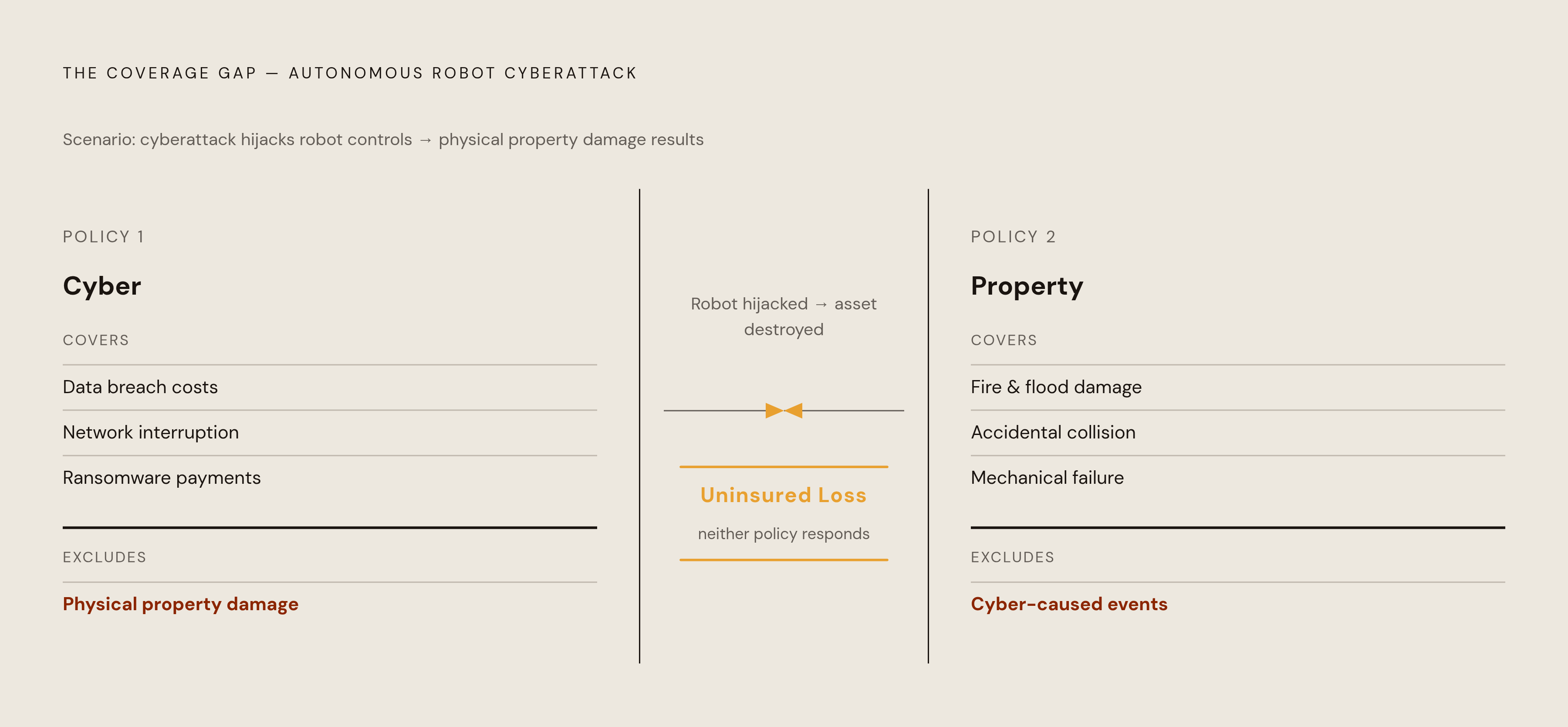
A cyberattack on an autonomous robot that causes property damage may encounter the cyber policy’s property-damage exclusion and the property policy’s cyber exclusion. The loss falls between the two policies. Explicit language is needed to close that gap, rather than an assumption that one insurer must respond because both policies exist.
Reinsurers also face accumulation exposure from widely deployed robotic platforms. A software update, cloud outage, or vulnerability can affect thousands of devices simultaneously without a geographic boundary. Unlike a hurricane or factory fire, the common cause is not confined to a location. Combined with uncertain claims history and multi-party liability, that exposure gives underwriters a strong incentive to exclude operations they cannot confidently price.
The coverage lines an autonomous hardware operator actually needs, and where each one is now under pressure
Beyond what CGL covers, the coverage map spans six distinct lines, with space coverage relevant to companies whose operations create that exposure. These lines are not independent purchasing decisions. Each addresses a different loss, but its exclusions and conditions can shift the apparent responsibility toward another policy. A complete assessment therefore examines the interfaces as closely as the individual limits.
Product liability addresses design or manufacturing defects in the hardware. Gallagher Re has noted that it may respond to injury and property damage, particularly in jurisdictions that treat AI software as a product, depending on wording and exclusions. That legal treatment varies by geography and remains unsettled. Cyber coverage needs separate scrutiny because the physical-damage gap cannot be resolved merely by showing that a cyber policy is in force.
Equipment and inland marine coverage follows hardware beyond the company’s premises, including transit, customer sites, pilots, and demonstrations. That is a central exposure for deployed robotics. Standard commercial property protection stops at the company’s own walls, while valuable hardware may spend most of its working life elsewhere. The location of the equipment is therefore part of the coverage analysis.
Tech E&O covers financial loss from software errors and integration failures when the company sells the autonomy stack itself as a product. For AI-enabled systems sold to enterprises, it is non-negotiable. D&O addresses a different pressure point. Under Berkley’s absolute exclusion, a shareholder claim alleging that the board misrepresented the company’s AI risk posture may receive no response from the policy.
Space is a separate specialist line for launch, in-orbit, or reentry exposures. It encompasses pre-launch ground operations, launch and flight coverage, in-orbit property, third-party launch liability, and launch delay costs. Standard commercial placements do not encompass that market. Where those operations exist, the coverage programme must account for them without treating a terrestrial robotics placement as a substitute.
What underwriters now require from an autonomous hardware operator before they will quote
Underwriters increasingly ask what the system does, which decisions it makes autonomously, and how a human can intervene. A business description alone is insufficient. Applications also examine training-data sources, model providers, third-party APIs, software dependencies, cybersecurity controls, incident-response procedures, and contractual indemnification. This follows a familiar pattern from cyber insurance, where questionnaires evolved to examine IT security hygiene over the past decade.
Carriers require proof of continuous telemetry tracking and automated intervention mechanisms, rather than a general statement that the system is monitored. Audit logs are key when a system causes physical damage. Without them, coverage may be voided after a loss, making documentation relevant both to underwriting and to the eventual claim.
Underwriters also require documented deterministic safeguards against runaway execution cycles. Their absence can lead to outright denial or prohibitive premium penalties. Human-override and kill-switch design consequently belong in the technical account of the risk.
Records of design, training, and deployment are also needed. Without them, an operator may struggle to demonstrate that the system was not negligently designed or deployed, a prerequisite for coverage under many policies. Documentation has a direct underwriting consequence. A submission that shows sound governance and safety practices can help secure better terms, while poor or missing records can lead to exclusions or higher rates. Submission quality is therefore not a question of presentation alone, but of whether the carrier receives usable evidence about the risk.
What a specialty broker does before the submission is built that a generalist cannot
Carrier selection is the first consequential pre-submission decision. The standard market has moved toward exclusions, while specialty markets have developed explicit autonomous-operations coverage. A specialist identifies that appetite before routing the submission.
Axis Insurance built a programme specifically for companies that make and deploy autonomous robots. It covers bodily injury and property damage from AI navigation or perception failures, as well as physical damage caused by a cyberattack that takes over a robot’s controls. Its scope also includes production losses from software updates or sensor failures that take a robot offline without physical damage. That is a materially different coverage proposition. The programme also addresses failures triggered by third-party sensors or components where the claim lands on the integrator.
Even explicit robotics coverage is not a complete answer to multi-party liability. The broker must map the whole programme. Even with a specialty product, the broker must check which parties, activities, and losses each policy covers.
Submission architecture is the next distinction between specialist and generic work. A broker who understands telemetry, sensor architecture, human-override design, and kill-switch implementation can explain those features as risk-mitigating facts. The submission must describe what the autonomous system actually does, rather than leave the underwriter to infer its behavior from a broad category.
Before binding, a licensed broker also reviews the wording against the operator’s loss scenarios. The review asks whether coverage requires a human actor, whether AI-specific exclusions apply, and whether the insuring agreement responds to autonomous operations. Resolving them before finalization prevents coverage assumptions from surviving untested until a claim.
The insurance requirements buried in enterprise and government contracts that make pre-submission timing critical
Enterprise and government customers are making AI-specific insurance a condition of contract. Customers are asking either for affirmative coverage for AI mistakes or for contractual indemnification for AI-caused losses with no cap or insurance backstop. The distinction has immediate commercial consequences. An operator close to winning a customer can otherwise face a choice between delaying the deal and accepting obligations it cannot honor.
Companies that sell autonomous systems to enterprises should expect to need at least Tech E&O and cyber insurance. Contracts may also call for 30-day notice endorsements, additional insured status on general liability, and waiver of subrogation. These requirements belong in the placement discussion before negotiations close. A policy that addresses the technical exposure may still need specific contractual provisions before it satisfies the customer.
Autonomy placements take longer because fewer carriers have appetite. A scheduled pilot does not shorten that process. The submission must be built and in market before the contract negotiation closes, rather than after the operator discovers that procurement will not accept its certificate of insurance. A standard form with an AI exclusion cannot meet a requirement for affirmative AI liability coverage. Signing indemnification first leaves the operator with the contractual obligation before the insurance response has been established.
How to get a specialty placement done before the next deployment or contract negotiation
Preparation starts with an audit of the existing programme before the next renewal. Check for CG 35 08 or equivalent wording, AI exclusions across E&O and D&O, and cyber AI sub-limits that are inadequate for the company’s operations. This review establishes which protections already exist and which need to be addressed in the next placement.
Next, compile the evidence needed to describe the system. That includes architecture, telemetry and audit-log capabilities, human-override and kill-switch design, model providers, third-party software dependencies, incident-response procedures, and existing claims or incidents. The records are inputs the broker uses to build the submission from the company’s actual technical reality.
Engage a specialist before the deployment schedule is set and before contract negotiations close. The initial conversation can begin with a plain-English description of what the company builds and deploys. The broker then translates that account into a coverage map, carrier selection, and technical submission. Complexity belongs in that preparation.
The placement should be judged on both terms and price. Accurate descriptions of autonomous operations, documented safety architecture, and access to carriers with explicit appetite support stronger outcomes than a generic submission. Most commercial insurance placements already include broker commissions, so using a specialist for placement adds no cost beyond the premium. The next step is to put the operating description, technical records, and customer requirements in front of a specialist while there is still time to shape the submission.