Beazley Cyber and AI Exclusion Overlap in Autonomous Hardware Policies
Cyber and GL coverage gaps leave autonomous hardware operators exposed when AI systems fail.

Beazley’s affirmative AI cyber endorsement deals with AI-assisted attacks but does not cover every loss that involves an autonomous machine. Cyber coverage may stop at physical harm, while a general liability AI exclusion may remove protection for that same harm. Understanding that overlap requires separating the attacker’s use of AI from the insured’s own operations and reading both against the full coverage tower.
What Beazley's affirmative AI cyber endorsement actually says and what it does not say
Beazley’s initial affirmative AI wording, announced on 2026-09-17, dealt with AI-related risks already covered by cyber and tech E&O policies, mainly those from AI-driven cyberattacks. Its purpose was to affirm that a cyber criminal’s use of AI to increase an attack’s speed or scale does not itself take an otherwise covered event outside coverage. Autonomous phishing and AI-accelerated intrusion fall within that frame. The underlying policy still defines the covered loss.
Beazley’s Group Head of Cyber Risks described the move as delivering “certainty and clarity” on AI-driven attacks. That initial wording left open whether liability from an internal model, autonomous hardware stack or integrated vendor tool is covered when the insured’s own AI causes harm. Beazley subsequently launched separate endorsements on September 24–25 expressly addressing risks from insureds’ own AI operations.
Beazley’s announcement also described availability on an admitted basis in some, but not all, US jurisdictions through licensed insurance brokers, and on a surplus lines basis through licensed surplus lines insurance brokers. Each policy’s terms and conditions set out exactly what it covers. The endorsement cannot be read in isolation.
Why "attacker-side" and "insured-side" AI risk are categorically different exposures
Attacker-side AI is an external instrument used against the insured. Reconnaissance, phishing and intrusion remain recognizable cyber events when AI amplifies their frequency or scale. Insured-side AI has a different role entirely. It is the system the company builds or operates, making decisions that can translate into navigation errors, sensor failures or incorrect actuator commands.
Consider a delivery robot that misidentifies an obstacle and strikes a pedestrian. Liability concerns the robot’s own decision and the resulting injury. For an autonomous hardware operator, this is a primary exposure. An attacker-side endorsement answers a different question, so a founder who reads “affirmative AI cover” as protection for the fleet’s own failures has mistaken the instrument of an attack for the source of the company’s liability.
How "silent AI" entered the general liability system — and why it matters more for hardware companies than for software ones
Silent AI follows the same pattern as silent cyber, which the market spent a decade working through. When a policy neither affirms nor excludes an exposure, its scope can become a post-loss dispute. Express exclusions replace that uncertainty with a boundary. For hardware operators, however, that boundary can cut through the bodily injury and property damage protection on which their operations depend.
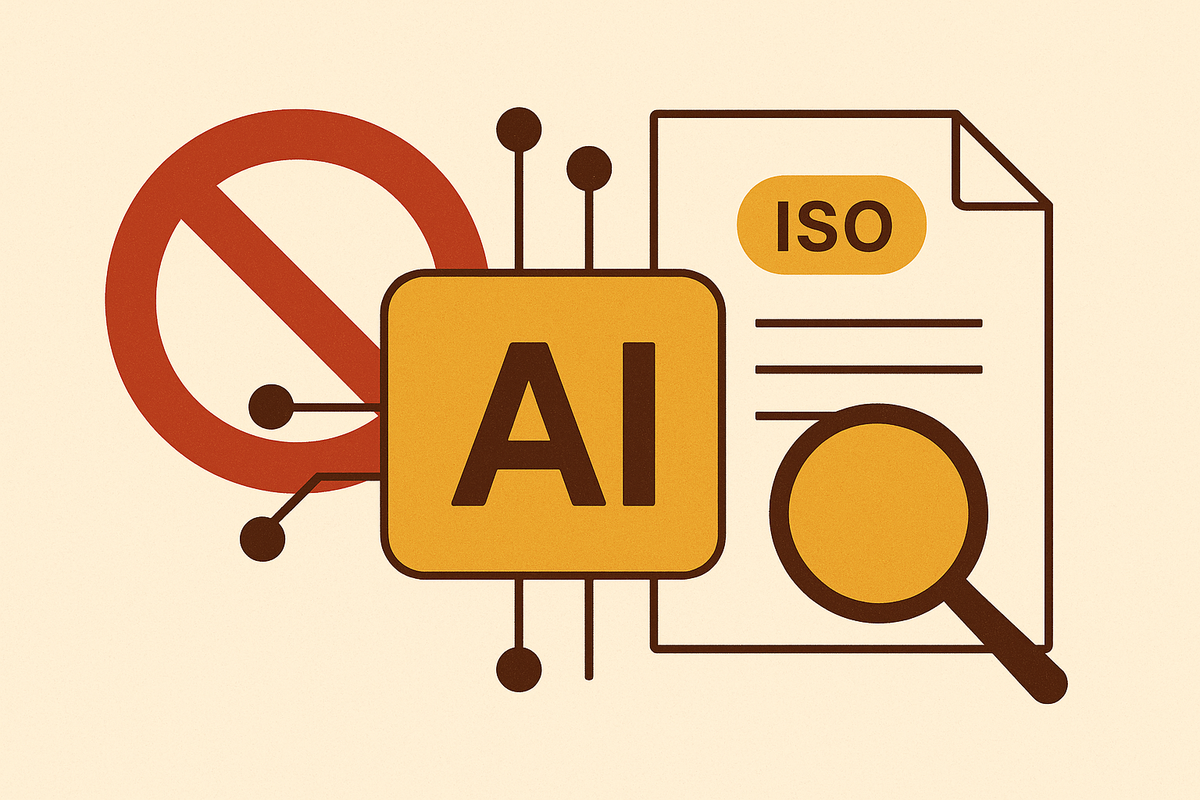
ISO’s CG 35 08 excludes bodily injury and property damage arising out of generative artificial intelligence under the Products/Completed Operations Liability Coverage Part. Its companion form, CG 40 47, addresses generative-AI-related bodily injury, property damage, and personal and advertising injury under Coverage A and Coverage B. The word “generative” is a substantive limitation. CG 35 08 defines the relevant system by its ability to create content or responses, including text, images, audio, video or code.
Consequently, AI-directed hardware is not automatically within that exclusion merely because it operates autonomously. Application depends on the system, the alleged cause of harm and the attached wording. ISO forms underpin a large share of U.S. property and casualty policies, making the distinction significant across placements. For software companies, generative-AI exclusions raise concerns about reputational or output-related claims. For hardware companies, an excluded output can also lead to injury or destroyed property, putting the physical liability layer at risk.
The specific scenario where the Beazley endorsement and a GL AI exclusion produce a coverage void simultaneously
Consider a cyberattack that takes over a robot’s navigation stack and causes it to injure someone or damage property. The initiating event is a network intrusion. If the attacker uses AI, the initial Beazley endorsement affirms that use within the existing cyber coverage framework. But recognizing the attack does not establish coverage for every consequence that follows.
Some cyber policies do not extend to bodily injury or third-party property damage, even when a network intrusion caused the loss. Those policies may cover the digital losses without covering the physical liability that follows. The distinction is between trigger and loss. An endorsement affirming the trigger does not, by itself, expand the categories of loss the policy covers.
The GL policy then presents a separate test. If an attached AI exclusion encompasses the navigation system’s role in the injury, it is designed to exclude that physical harm even though a human attacker initiated the sequence. Under the ISO generative-AI wording, that analysis requires a connection to generative AI. Where both boundaries apply, the tower can leave the physical liability without responding coverage.
The unprompted failure scenario: when no attacker is involved and the GL exclusion still applies
The broader operational exposure exists even without an attacker in the picture. A robot can make a wrong navigation or perception decision on its own, injuring a bystander or damaging property. Here, attacker-side affirmation has no work to do. The analysis turns to whether liability coverage includes the machine’s own decision-making and whether an attached exclusion encompasses the system and the harm.
If the AI exclusion applies to the failure, GL coverage is still excluded even when there is no cyberattack. The exclusion concerns the origin of the harm. Yet direct physical damage is only one layer. A robot failure can also shut down a customer’s operation, creating production losses and downstream consequences that generic GL coverage may not address even when it responds to the immediate damage.
For hardware companies that are part of enterprise supply chains, those consequential losses can be worth more than the damaged property. That extends the coverage problem beyond AI exclusions. A policy that covers an injured person or broken equipment is not necessarily a policy that covers the customer’s interrupted production.
Why the standard cyber-plus-GL tower was never architected to cover physical AI liability in the first place
Autonomous robotics crosses cyber, professional and tech E&O, property, general liability, products liability and employers’ liability. No single standard policy was built to cover that mix. Each line has its own insured interests, triggers and exclusions. Autonomous hardware joins them through a system whose software decisions produce physical consequences, exposing boundaries that a conventional cyber-plus-GL placement may leave unresolved.
Where wording requires a human actor to be responsible for an act or event, autonomous decision-making raises a question that ordinary professional-error assumptions do not answer. No human need have made the proximate choice. That makes affirmative treatment of autonomous acts important to determining which policy is intended to respond.
A cyberattack may damage an autonomous robot while a cyber exclusion limits the property policy and the cyber policy does not cover the physical loss. Both restrictions can operate at once. The resulting gap is a consequence of product design. Specialist construction is needed because placing standard policies next to each other does not alter their boundaries, and an attached AI exclusion can make those boundaries more restrictive.
What a coverage tower built for autonomous hardware actually needs to contain
The practical response is to construct coverage around the losses autonomous operations can produce. A suitable tower must affirmatively address AI-directed bodily injury and property damage, cyber-triggered physical harm, consequential production losses from software or sensor failures even without physical damage, and third-party component failures for which the integrator faces the claim. These are separate coverage requirements. Their allocation across the tower must leave neither autonomous decisions nor the transition from digital failure to physical harm unresolved.
The cyber component must address what happens when a covered cyber event causes real-world injury or damage. The GL component requires review at every renewal for CG 40 47 and CG 35 08 on the schedule of forms, together with the actual scope of any relevant exclusion. An endorsement added at renewal can change coverage that previously satisfied a contract requirement. Whether an ISO generative-AI exclusion reaches the operation still depends on the system and the wording, rather than the company’s general description as an AI business.
The physical hardware also needs accurate treatment under inland marine coverage. Autonomous units should be scheduled with granular specifications supported by telemetry data, system architecture and operating-domain information. Detail reduces the uncertainty underwriters must price. It also gives the schedule the specificity needed for scrutiny after a unit is damaged or destroyed. Tech E&O requires a separate check that AI-directed errors, rather than only human professional errors, are covered and that its own AI exclusions do not recreate the gap.
Beazley’s Full Spectrum Cyber offering includes an AI Voluntary Shutdown solution for organizations that need to stop a malfunctioning AI system before it causes major harm to their finances and reputation. It also includes AI Regulatory Defence and Penalties cover for clients who face a regulatory investigation after they unintentionally misuse AI. Hardware operators should review how those components fit within the cyber layer. Neither description alone establishes bodily injury or property damage protection, so their role must be assessed against the physical and consequential losses the rest of the tower is intended to address.
How the underwriting submission determines whether the specialist coverage actually binds as intended
The underwriting submission turns that coverage design into a description an underwriter can assess and price. For autonomous hardware, it must explain what the system actually does, rather than leave its decision-making hidden inside a generic technology classification. Generic descriptions invite generic coverage. A submission that does not distinguish autonomous physical operations from software services can leave the same unresolved boundaries that specialist placement was intended to close.
Historical loss data for robotics and AI hardware risks is thin. Telemetry data, system architecture diagrams, failure-mode documentation and AI governance policies give the underwriter more to work with when judging the exposure. That evidence affects both premium and coverage breadth. It helps distinguish a risk that can be described and priced from uncertainty for which the underwriter may load the premium or restrict terms.
The submission review also exposes a contract-compliance trap. A CGL policy may appear to satisfy an enterprise customer’s general liability requirement while an attached generative-AI exclusion removes coverage for the particular hardware-related exposure the customer intended to transfer. A certificate of insurance is not enough. The exclusion sits on the schedule of forms, and the certificate will not reliably flag its presence or explain its effect on the insured’s operations.
Cyber underwriters are adapting their questions to assess AI controls and governance processes, making the translation from engineering documentation to insurance terms consequential. The submission should show how those controls relate to the company’s own AI decisions, the physical harm they could cause and the downstream losses that could follow. Specialist coverage depends on that description reaching the bound wording. The final test is not whether the policy mentions AI, but whether its insuring agreements and exclusions address the autonomous operations the underwriter was asked to cover.