Florida Surplus Lines Market AI Exclusion Trends for Maritime Autonomous Vehicles
AI exclusions in maritime policies may void the coverage operators thought they were buying.

Florida’s surplus lines market has become the primary underwriting venue for maritime autonomous vehicles, but access to insurance is not the same as protection. The rule changes made placement faster but left policy exclusions unchanged. For operators, the least-examined exposure is therefore not whether coverage can be bound, but whether AI exclusions remove protection for the systems on which their vessels depend.
Why maritime autonomous vehicles land in Florida surplus lines
Maritime autonomous vehicles exist and need insurance, but admitted carriers have no standard form for vessels that combine new technology, an undefined loss history, and operations the carriers are not used to. These vessels do not fit conventional underwriting categories. Their software, sensors, and remote control arrangements create exposures that standard admitted carriers decline to insure on standard terms. Surplus lines provides a placement channel for that mismatch, allowing specialty insurers to assess risks outside the admitted market’s usual forms.
Florida Statute §626.918 establishes the financial framework for eligible surplus lines insurers, including a requirement to maintain surplus of not less than $15 million. Commercial wet marine and transportation risks also have specific exemptions under §626.916, which free them from the diligent effort search and insured disclosure requirements. The exemption is partial: under Section 626.917, placement must still go through a licensed surplus lines agent and an OIR-eligible insurer. Within those constraints, autonomous vessel risks can reach specialty marine markets whose underwriting conventions for autonomy remain unsettled.
How Florida's 2025 regulatory change accelerated placement into E&S without improving what those policies cover
Florida’s 2025 regulatory change made it easier for frontier technology companies, including maritime autonomous vehicle operators, to place risks directly into excess and surplus lines. Removing admitted-market declination paperwork cut the time needed for placement. It also removed a step that had prompted at least a cursory examination of whether standard coverage could work. For qualifying wet marine risks, this broader shift reinforces an existing route into specialty markets.
The reform addressed access through Florida’s Rule 69O-136.004, effective March 2025 with a technical change in April 2026, which governs carrier eligibility and filing obligations but sets no coverage adequacy standards for novel autonomous risks. S.B. 1028, enrolled March 17, 2026, required Citizens Property Insurance Corporation to set up both admitted and surplus lines commercial risk clearinghouses. That separate effort continued the state’s emphasis on changing how commercial risk reaches insurers, without dictating what their policies must cover.
What standard maritime law assumes about human command — and why autonomous vessels break those assumptions at the claim stage
Maritime liability rules assume a human master making navigational decisions. Removing that person, or relocating decision authority to a shore-based remote operations centre, complicates the attribution of fault. COLREGS, the international collision-avoidance regulations, are built around command and the exercise of seamanship, without a direct mapping to autonomous navigation. The Hague-Visby Rules’ navigational fault defence likewise requires a navigational error committed by a person. It is still unclear whether that protection holds when navigation is automated.
Those ambiguities reach the claim before policy exclusions do. A cyber-attack on navigation, software failure causing grounding, sensor malfunction leading to collision, or communication loss with a remote operations centre has no direct precedent in P&I claims history. Liability may involve the shipowner, software provider, and remote operations company, with the allocation between them unresolved. Before July 2026, the International Group of P&I Clubs had not produced uniform wording for autonomous vessel risk, and clubs handled entries case by case. Their own underwriting criteria continued to govern entries after the pooling development.
The IMO’s MASS Code established an operational framework. Adopted 22 May 2026 at the 111th session of the Maritime Safety Committee and effective 1 July 2026, it addresses design, construction, certification, and operation but explicitly does not address legal liability. Its four degrees distinguish automated processes with seafarers onboard, remote control with seafarers onboard, remote control without seafarers, and full autonomy. Those distinctions give underwriting submissions a more precise vocabulary. They do not settle who pays when an autonomous system causes a casualty, making the policy’s exclusion language more consequential.
The partial step the P&I market took in July 2026 — and the gap it left for E&S operators
The International Group’s July 2026 confirmation allowed liabilities from autonomous surface ships into its pooling arrangements at all degrees of autonomy, including fully unmanned vessels. On-water third-party liabilities arising from remote operations centre conduct, such as a collision caused by a remote operator, continue to fall within standard mutual P&I cover. However, remote operations centre personnel are not treated as seafarers for P&I purposes, and their land-based liabilities are not P&I risks.
The distinction limits the announcement’s reach without diminishing its value. The confirmation leaves out land-side remote operations centre exposures, first-party cyber losses, and property risks, and questions remain about what cover and limits are available for vessels of different size and scale. Florida E&S also serves smaller companies, startups, and vessels not yet operating at commercial scale. Pooling eligibility does not automatically give those operators coverage they can bind on accessible terms. Their insurance arrangements still need separate cyber, property, and professional liability protection, precisely where AI restrictions are developing rapidly.
How ISO's 2026 AI exclusion forms reach maritime autonomous vehicle policies through the E&S channel
ISO issued three generative AI exclusions for commercial general liability in January 2026, namely CG 40 47, CG 40 48, and CG 35 08. These forms give insurers ready-made wording they can use at renewal to restrict cover for AI-related liability. CG 35 08 addresses bodily injury or property damage within the products and completed-operations hazard. For an autonomous vessel company, that makes the form relevant to claims involving the performance of a supplied physical system, subject to the endorsement’s actual terms.
The generative AI scope is an important boundary. CG 35 08 should not be treated as an automatic exclusion of every failure involving autonomous navigation, software, or sensors. It is designed to exclude the specified generative-AI-related injury or damage within the stated hazard. Whether it would apply to a particular vessel loss depends on the policy wording and the function involved. Underwriting therefore requires assessing how the endorsement’s scope intersects with the system, regardless of whether the vessel is broadly described as AI-enabled.
Regulatory filings show that the exclusion wave extends beyond CGL. More than 60 property and casualty groups have engaged with AI exclusions across Commercial Umbrella/Excess, CGL, Other Liability, Commercial Package/BOP, D&O, and Professional Liability. State insurance regulators have approved the large majority of those applications, with Florida among the states recording the highest approval volumes. In this active exclusion market, operators placed through specialty channels must still distinguish between an available form and the endorsement actually attached to their contract.
The six coverage lines maritime autonomous vehicle operators need — and where AI exclusions are cutting into each
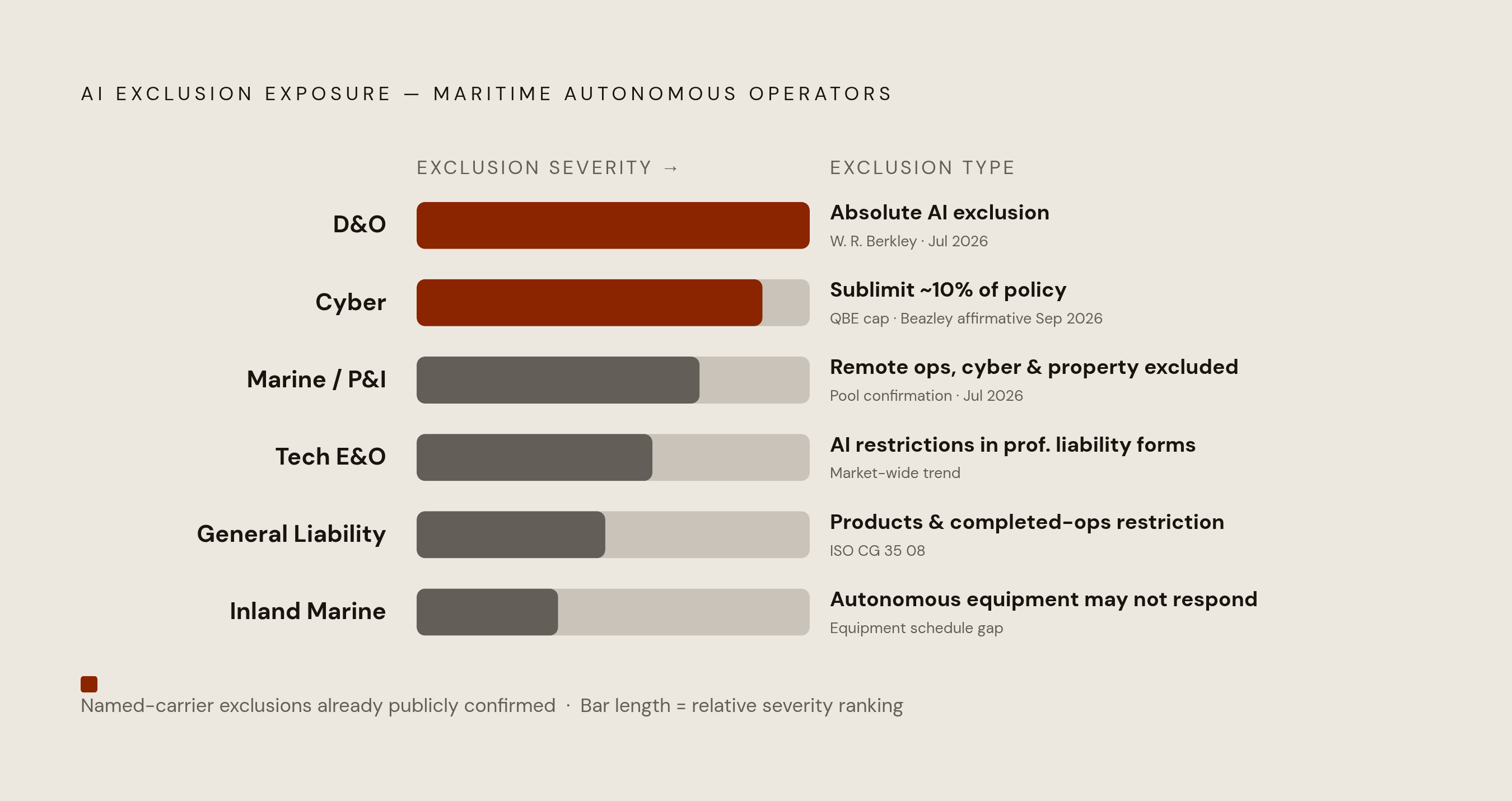
Cyber provides the clearest example of a hidden limit. QBE has introduced sublimits capping AI-related cyber losses at roughly 10% of the total policy limit. Beazley explored similar language but announced affirmative AI coverage in its cyber policies as of September 2026. The difference shows why nominal limits alone cannot establish the protection available for an AI-linked breach. After high-profile ransomware attacks on port terminals and container tracking systems, underwriters also require specific cybersecurity controls as conditions of coverage.
General liability is the first point of contact for bodily injury and property damage from physical operations, making CG 35 08 particularly relevant where its generative AI scope intersects with vessel functions. Its products and completed-operations restriction is not interchangeable with a general software exclusion. Technology E&O is required for software errors, bad model outputs, and intellectual property claims, so GL and Technology E&O must be considered together.
Technology E&O addresses claims arising from software, firmware, embedded systems, and connected device platforms, including malfunction, inaccurate data output, and performance failure. That protection is key because software controls how the vessel behaves. An E&O policy may still leave some of what CGL excludes uncovered, especially as AI restrictions also reach professional liability forms. The gap between the two policies depends on their respective grants of coverage and exclusions.
Inland marine and equipment coverage applies to physical vessels, sensor arrays, and prototype hardware while they are in transit or deployed. This is often where admitted carriers first decline an autonomous vessel company, directing it toward E&S. The equipment schedule is a critical boundary. A schedule written for conventional vessels may not respond to losses involving autonomous or connected equipment, including sensor arrays and communication systems.
D&O protects founders, executives, and board members against investor claims, allegations of breached fiduciary duty, and regulatory actions. Autonomous vessel companies that have received funding need this separate layer. W. R. Berkley’s absolute AI exclusion, reported in July 2026, shows that management liability is not insulated from the exclusion wave. A claim over a board’s decisions on AI deployment could therefore lead to a dispute over coverage even when it concerns how the company was governed.
Marine and P&I completes the six-line structure with third-party maritime liability protection. The July pooling confirmation supports autonomous operations within its scope, but does not replace first-party cyber, property, or land-side protection. Smaller operators and those at an earlier stage may instead rely on Florida’s E&S marine specialty market. Those policies have no standard obligation to preserve coverage terms from year to year, leaving renewal wording as a separate source of uncertainty.
Why the submission a maritime autonomous vehicle company sends to E&S carriers determines whether AI exclusions apply narrowly or broadly
An underwriting submission shapes the exclusion language offered at binding by defining what the insurer understands the operation to be. A generic AI-enabled description leaves critical distinctions unresolved. The MASS Code framework lets an operator identify whether seafarers remain onboard, where remote control is exercised, and whether the vessel is fully autonomous. Precise descriptions of human oversight give underwriters a firmer basis for distinguishing specific exposures rather than applying a broad restriction to an undifferentiated technology risk.
That precision requires more than an autonomy label. A field-operation submission describes the remote operations centre’s decision authority, the sensor and software stack, cybersecurity controls, and the operational envelope. Florida’s wet marine exemption often sends these submissions to specialty markets that have yet to agree on standard ways to handle autonomy. A conventional commercial marine submission can therefore leave the features most relevant to an AI exclusion unexplained. Better disclosure can support narrower wording, although the submission itself does not override the contract ultimately bound.
The Florida Surplus Lines Service Office invested $1 million in 2026 to establish the Florida Surplus Lines Insurance Directorship at FSU’s Wertheim College Risk Management and Insurance Center. For autonomous vessel placements, the practical distinction is whether the submission translates technical operations into exposures an underwriter can assess. Without that translation, standard marine descriptions leave too much room for broad treatment of the vessel’s AI functions.
What maritime autonomous vehicle operators should audit in their current E&S policies before the next renewal
Operators should start the renewal audit with their bound policy documents because AI restrictions are already in use in the market. The first check is the CGL endorsement schedule. Review whether CG 35 08 or equivalent wording is attached and whether its products and completed-operations restriction would apply to the vessel’s autonomous navigation functions. That assessment should distinguish the actual role of generative AI from a general description of the vessel as autonomous.
The cyber review should check how much cover is available for AI-driven breach scenarios. Sublimits can change the available protection substantially. Operators should also identify which cybersecurity controls are conditions of coverage. The D&O review should look for an absolute AI exclusion of the type introduced by Berkley in July 2026 and establish whether board decisions involving AI deployment remain within covered activity.
Operators should verify that the declared degree of autonomy matches the MASS Code framework and that remote decision authority, software architecture, and the operational envelope are described specifically. Because E&S terms need not remain the same each year, renewal can introduce a restriction even when the operator has requested no change. Comparing that wording with the current operation is the practical next step. An AI exclusion tracker can help operators keep up with new forms and restrictions for later reviews.