How Insurers Conflate Autonomous Hardware With Software AI Risk and Why That Triggers the Wrong Exclusions
Broad AI exclusions written for chatbots can strip coverage from robots.
Strong underwriting submissions for autonomous hardware give substance to the label “an AI system” by describing the machine’s physical operation, sensor inputs, decision envelope, and failure modes. Software-centric descriptions invite software-centric exclusions that can reach bodily injury, property damage, and production loss. Wording drafted for software AI can exclude a different physical risk even though autonomous machines are not inherently uninsurable.
How AI exclusion language written for software ends up stripping coverage from physical machines
A robot navigating a warehouse can injure a worker, damage property, or interrupt production when its decisions go wrong. A drone that chooses its route mid-flight poses another physical risk. Neither is simply producing advice on a screen. Yet an exclusion drafted with chatbots, hallucinations, and generative outputs in mind may reach both machines if its definition extends to any system using a model to make decisions.
The mismatch begins in the wording. Software AI exposures such as bad advice and generated content can cause losses in different ways from a machine moving through physical space. A broadly worded exclusion can hide that difference before anyone looks at the conditions in which the machine works. This requires only a definition wide enough to group content generation and physical actuation together, despite the different risks an underwriter would need to assess.
What “automated” and “autonomous” actually mean, and why the difference determines who pays
An automated welding robot executes predefined rules and repeats the same weld thousands of times. Its operation is bounded and deterministic. Legacy machinery underwriting was built around that kind of predictability, including systems controlled by PLCs, relays, and hydraulics. An autonomous machine instead perceives its environment, reasons about uncertainty, and adapts its actions. For insurance, what matters is how a loss can arise, regardless of whether the manufacturer uses an advanced technology label.
A robotics framework distinguishes automation that extends human capability through programmed rules from autonomy that adapts toward goals beyond explicitly programmed actions. Applied to hardware underwriting, that distinction makes the machine’s decision envelope more useful than the word “autonomous” alone. Human oversight also changes the exposure. The framework’s cybersecurity application places systems marketed as autonomous at levels 3–4 on a 0–5 scale, with human review still required for edge cases. That finding shows why insurers need information beyond a marketing label to understand what a system can do.
Conflation creates errors in both directions for insurers. A broad AI exclusion may apply to a robot even if it has no generative-content function. Conversely, an underwriter who treats an autonomous machine as a software platform may underprice its physical exposure. The relevant distinction is therefore not simply whether AI is present, but what decisions the system makes and how those decisions affect people, property, and operations.
The wave of AI exclusion filings in 2025–2026 and how the standard forms were structured
The exclusion wave turned this drafting problem into a live policy issue. Verisk/ISO made its multistate generative AI exclusion filing in July 2025, during the summer when the push began. More than sixty property and casualty providers filed AI exclusions in 2026. By April 2026, state regulators had approved more than four-fifths of insurer requests to exclude AI-related damages from corporate policies. Regulatory approval, however, does not establish that an exclusion fits a particular machine.
ISO/Verisk introduced three generative AI exclusion endorsements for commercial general liability policies, effective January 1, 2026. The identifiers are CG 40 47, CG 40 48, and CG 35 08. CG 35 08 specifically removes bodily injury and property damage arising out of generative artificial intelligence in the products and completed operations coverage part. Its scope deserves careful distinction from an exclusion of all AI. A hardware company’s exposure depends on the attached wording and the system involved.
Some forms written by insurers reach well beyond generative AI. Absolute exclusions in D&O, E&O, and fiduciary liability can apply to claims “based upon, arising out of, or attributable to” AI used “by any person or entity.” Such wording can reach a hardware business using a third-party model it did not develop. The rationale is coherent in its original context. With more AI litigation and software vendors accepting little liability, insurers worry about the exposure left to them, but that concern alone does not separate a chatbot supplier from a robot manufacturer.
Why CGL, tech E&O, and product liability wordings misfire simultaneously on a single robot incident
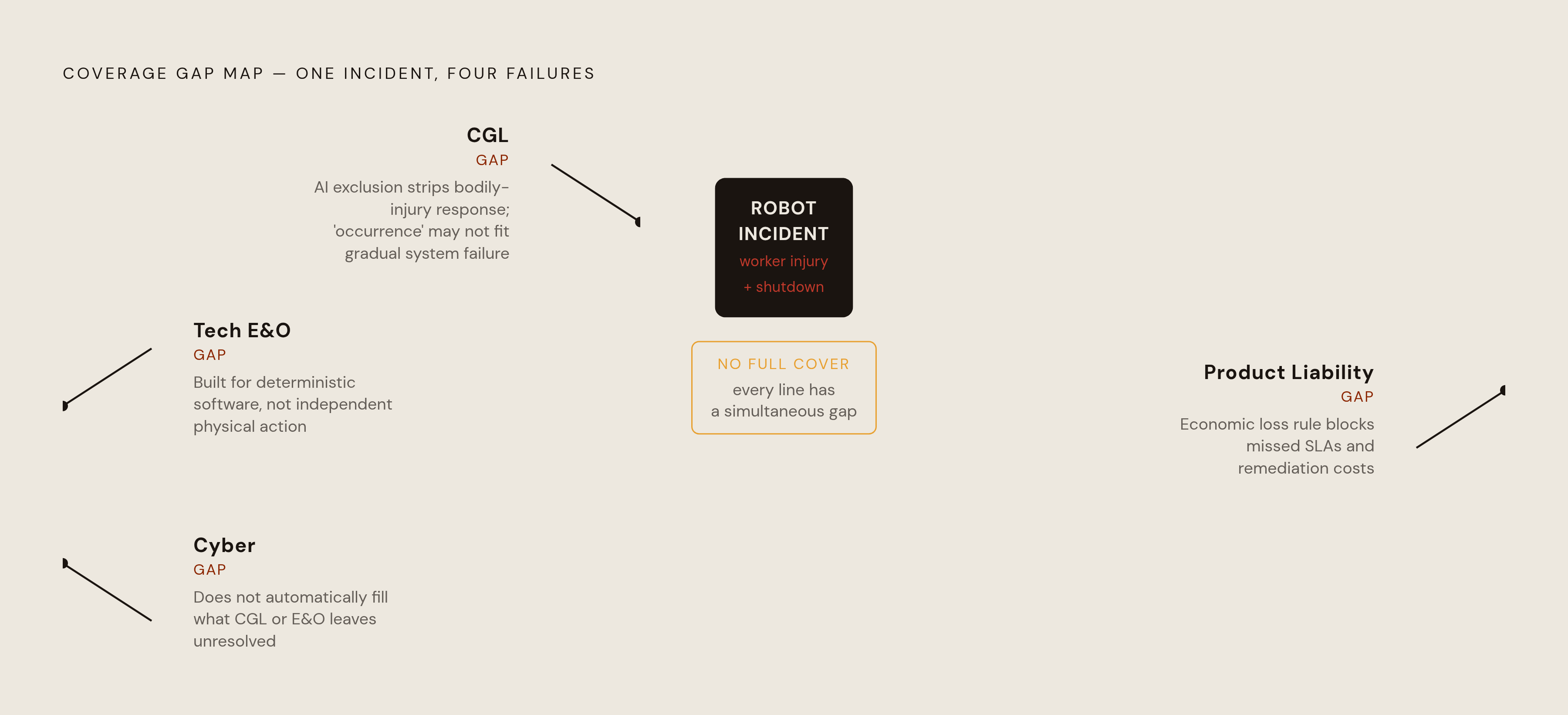
Consider a hypothetical warehouse robot that misclassifies an obstacle, injures a worker, and causes a production shutdown. One event creates several different insurance questions. WTW’s Andrew Hill identifies autonomous robotics exposures across cyber, professional and technology E&O, property, general liability, products liability, and employers’ liability. Many policies are agnostic about whether a person or an autonomous system caused the loss, while others still assume human involvement. The hypothetical therefore requires analysis of the “AI” exposure across the policy stack.
CGL is designed to address accidental bodily injury and property damage, making those parts of the incident relevant to its coverage. An applicable AI exclusion could restrict that response. The definition of an “occurrence” can also require scrutiny where a system failure develops over time without one discrete trigger. ISO’s generative AI forms should not be treated as interchangeable with broader absolute exclusions. The latter may extend to predictive or scoring tools and, potentially, models directing physical movement.
Tech E&O addresses another part of the problem. It may respond to technology errors causing financial loss, but traditional wording was built around deterministic software and human-delivered services. That does not necessarily accommodate a system taking independent physical actions. Product liability may address bodily injury and property damage where the relevant jurisdiction treats AI software as a product. Pure economic losses, including lost production, missed SLAs, and remediation costs, are generally restricted by the economic loss rule, although some jurisdictions permit consequential financial losses tied to covered injury or damage.
The manufacturer, model supplier, and operator may consequently look to different policies for the same incident. Each policy has its own coverage grant, exclusions, and scope limits. A cyber policy does not automatically fill whatever CGL or E&O leaves unresolved. Overlapping coverage disputes may leave the incident without a complete response, although the actual terms and applicable law decide whether any particular policy pays.
The “silent AI” problem that preceded the exclusion wave and still affects policies that predate 2026
“Silent AI” describes wording that neither affirmatively covers nor expressly excludes AI-caused losses. A hardware company may read that silence as protection, only to face a coverage dispute when a claim arrives. Even a successful challenge imposes the cost of litigation. Meanwhile, exclusions added at renewal can replace uncertainty with an express restriction that the company has not recognized.
Adoption outpaced understanding of how technical risks translated into insured losses, and unexpected claims pushed the market toward explicit coverage language. Physical AI is at an earlier point in that development. For companies with pre-2026 wording, the absence of a new exclusion therefore leaves them to establish whether their machines’ failure modes are covered.
What the first robot-specific policies reveal about where standard language fails
Specialist products are useful evidence of how standard wording can fail to cover physical risks. A facility for Uber’s autonomous vehicle partners, launched in March 2026, uses exposure-based pricing, including per-mile, per-delivery, and per-trip measures. The pricing unit reflects the machine’s activity.
An AI robot insurance product set to launch in November 2026 spells out coverage for replacement-worker wages and substitute-robot rental fees while a machine is unavailable. Those provisions recognize that the machine is also performing work. They identify a loss beyond physical damage to the equipment itself. These provisions name the costs that follow when a machine stops work, costs that a general technology or machinery form cannot be assumed to cover.
These products do not yet have decades of actuarial history, published failure-rate baselines, or standardized diagnostic-coverage reporting behind them. The specialist market is developing ahead of that data. The specialist market shows that coverage can be written for physical autonomy, though its existence alone does not show that there is enough capacity for every exposure. Capacity is still limited compared with AI litigation exposures already running into the billions.
What makes a strong underwriting submission for an autonomous hardware company
For a hardware company seeking appropriate coverage, the practical leverage point is the underwriting submission. A strong submission distinguishes physical autonomy from software AI through four concrete elements, namely physical operation, sensor inputs, the decision envelope, and failure modes. These elements explain what the machine does and where its decisions can produce loss. The phrase “AI-powered platform” does not provide that information. Without it, an underwriter may apply the classifications and exclusions used for a software business.
The comparison is concrete in the warehouse example. Calling the obstacle error only an incorrect AI output draws attention to technology E&O and AI exclusions. Describing the machine’s operation and the resulting injury or property damage also makes its machinery, CGL, and product liability exposures visible. The submission can determine which exposures the underwriter considers before selecting the eventual contract.
A submission should distinguish predefined operation from adaptive decisions and explain the role of human review. Its account of failure modes should connect the machine’s decisions to the physical and financial losses at issue. That gives an underwriter a basis for distinguishing bodily injury, property damage, and operational interruption rather than treating them as interchangeable consequences of an AI error.
Generic forms often lack fields for these distinctions. With those fields missing, a standard technology-business submission can put a robotics company in a SaaS-shaped category even when no one has set out to misrepresent the business. Submission quality for autonomous hardware is the quality of the link between machine behavior, loss mechanism, and proposed coverage. Specialist placement adds value when it makes that link legible to insurers writing suitable forms, rather than merely circulating the same generic description more widely.
What a hardware company should look for — and push back on — when reviewing its current policy stack
For a company reviewing existing coverage, the starting point is the insuring agreement and its endorsements. Hill’s framing is whether specific wording covers the specific loss mechanism, rather than whether a policy generally responds to “AI.” A broad coverage grant may offer little protection if an attached endorsement excludes the main exposure from running the machine.
An exclusion referring to losses “arising out of, attributable to, or in connection with” any AI may reach physical autonomy even if its original concern was generated content. A tech E&O agreement centered on human-delivered professional services raises a different question if it has no affirmative treatment of autonomous operation. An absolute management liability exclusion extending to AI “used by any person or entity” can also implicate third-party models.
The review must extend beyond AI-specific clauses themselves. Missing inland marine or equipment coverage can leave hardware in transit or at customer sites without the relevant protection. Product liability wording addressing injury and damage may still leave production downtime or missed SLAs unresolved. These are distinct gaps, even when one robot failure exposes all of them. Treating the stack as a collection of policy titles obscures those boundaries.
A company should ask its broker to identify the specific endorsement form numbers and any wording that assumes human involvement. It should also ask which coverage line would respond if a software update took the fleet offline without physical damage. Another necessary question is who bears the loss when a third-party sensor defect produces a claim against the company as integrator. These questions test mechanisms. They force the discussion toward the machine and the loss before a claim forces it there.
Broker commissions are already embedded in the premium whether a standard broker or a specialist places the policy. The specialist’s value is therefore not simply access. It lies in showing the physical exposure accurately and getting wording that covers it. A hardware company should expect the submission and the resulting policy to distinguish the machine it operates from the software category into which an imprecise description might place it.